| . |  |
. |
| . | |
. |


 by Staff Writers New Haven CT (SPX) Dec 14, 2017
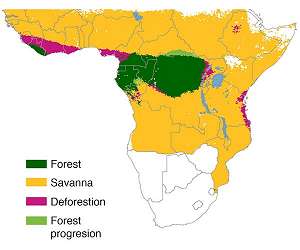
The loss of forests in Africa in the past century is substantially less than previously estimated, an analysis of historical records and paleontology evidence by Yale researchers shows. Previous estimates put deforestation at 35% to 55% on the continent since 1900. The new analysis estimates closed-canopy forests have shrunk by 21.7%, according to findings published Dec. 11 in the journal Nature Ecology and Evolution. However, research also shows that some West and East African forests have been reduced between 80% and 90%. Earlier surveys incorrectly labelled ancient savannas as newly deforested regions, said A. Carla Staver, assistant professor of ecology and evolutionary biology and senior author of the study. The new analysis should help focus conservation efforts in Africa, she said. "There is a global effort to increase the number of trees that can trap carbon," Staver said. "In Africa, it would make the most sense to focus these efforts in areas that have truly been deforested rather than in areas which have long been savannas." Staver and former Yale postdoc Julie C. Aleman, now at the University of Montreal, used traditional sources such as early 20th-century European maps to estimate the extent of African forests in 1900. But the team also cross-checked the documents with paleontological records - including pollen, leaf parts known as phytoliths, and charcoal preserved in lake sediment and soil - to reconstruct the historical ecology of tropical regions of Africa. The single greatest contributor to continental deforestation was conversion of forests in West African countries including Ghana and Sierra Leone. However, the team also found that forests had actually expanded in Central African countries such as the Democratic Republic of the Congo and Central African Republic. "As conservationists, it is easy to look at this study as good news - that deforestation isn't as bad as we thought," Staver said. "The bad news is that central African forests have been spared because violent conflicts have prevented economic development, at the costs of human lives and livelihoods."
 Forests are the key to fresh water
Vancouver, Canada (SPX) Dec 11, 2017 Freshwater resources are critical to both human civilization and natural ecosystems, but UBC researchers have discovered that changes to ground vegetation can have as much of an impact on global water resources as climate change. UBC Okanagan Earth, Environmental and Geographic Sciences Professor Adam Wei, PhD candidate Qiang Li and researchers from the Chinese Academy of Forestry recently ... read more Related Links Yale University Forestry News - Global and Local News, Science and Application

|
|||||||||||||
| The content herein, unless otherwise known to be public domain, are Copyright 1995-2026 - SpaceDaily. All websites are published in Australia and are solely subject to Australian law and governed by Fair Use principals for news reporting and research purposes. By using our websites you consent to cookie based advertising. If you do not agree with this then you must stop using the websites from May 25, 2018. Privacy Statement. Additional information can be found here at About Us. |

 del.icio.us
 Digg
Digg Reddit
 Google






