| . |  |
. |
| . | |
. |


African Remanent Ice Cap All Gone Soon
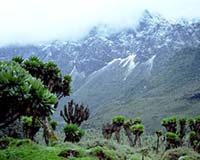
Washington DC (SPX) May 16, 2006 Fabled equatorial icecaps will disappear within two decades, because of global warming, a study British and Ugandan scientists has found. In a paper to be published 17 May in Geophysical Research Letters, they report results from the first survey in a decade of glaciers in the Rwenzori Mountains of East Africa. An increase in air temperature over the last four decades has contributed to a substantial reduction in glacial cover, they say. The Rwenzori Mountains--also known as the Mountains of the Moon--straddle the border between the Democratic Republic of Congo and the Republic of Uganda. They are home to one of four remaining tropical ice fields outside of the Andes and are renowned for their spectacular and rare flora and fauna. The mountains' legendary status was set during the second century, when the Greek geographer Ptolemy made a seemingly preposterous but ultimately accurate statement about snow-capped mountains at the equator in Africa: "The Mountains of the Moon whose snows feed the lakes, sources of the Nile." The glaciers were first surveyed a century ago when glacial cover over the entire range was estimated to be 6.5 square kilometers [2.5 square miles]. Recent field surveys and satellite mapping of glaciers conducted by researchers from University College London, Uganda's Makerere University, and the Ugandan Water Resources Management Department show that some glaciers are receding tens of metres [yards] each year and that the area covered by glaciers halved between 1987 and 2003. With less than one square kilometer [half a square mile] of glacier ice remaining, the researchers expect these glaciers to disappear within the next 20 years. Richard Taylor of the University College London Department of Geography, who led the study, says: "Recession of these tropical glaciers sends an unambiguous message of a changing climate in this region of the tropics. "Considerable scientific debate exists, however, as to whether changes in temperature or precipitation are responsible for the shrinking of glaciers in the East African Highlands that also include Kilimanjaro [in Tanzania] and Mount Kenya." Taylor and his colleagues found that in the Rwenzori Mountains since the 1960s, there are clear trends toward increased air temperature without significant changes in precipitation. A key focus of the research is the impact of climate change on water resources in Africa. Glacial recession in Rwenzori Mountains is not expected to affect alpine river flow, the scientists say, due to the small size of the remaining glaciers. It remains unclear, however, how the projected loss of the glaciers will affect tourism and local traditional belief systems that are based upon the snow and ice, known locally as "Nzururu." "Considering the continent's negligible contribution to global greenhouse-gas emissions, it is a terrible irony that Africa, according to current predictions, will be most affected by climate change," added Taylor. "Furthermore, the rise in air temperature is consistent with other regional studies that show how dramatic increases in malaria in the East African Highlands may arise, in part, from warmer temperatures, as mosquitoes are able to colonize previously inhospitable highland areas." Title: "Recent glacial recession in the Rwenzori Mountains of East Africa due to rising air temperature" Authors: Richard G. Taylor: Department of Geography, University College London, London, United Kingdom; Lucinda Mileham: Department of Geography, University College London, London, United Kingdom; Callist Tindimugaya: Water Resources Management Department, Directorate of water Development, Entebbe, Uganda; Abushen Majugu: Meteorology Department, Kampala, Uganda; Andrew Muwanga: Department of Geology, Makerere University, Kampala Uganda; Bob Nakileza: Department of Geography, Makerere University, Kampala Uganda. Citation: Taylor, R.G., L. Mileham, C. Tindimugaya, A. Majugu, A. Muwanga, and B. Nakizela (2006), Recent glacial recession in the Rwenzori Mountains of East Africa due to rising air temperature, Geophys. Res. Lett., 33, [TBD], doi:10.1029/2006GL025962. Related Links University College London Joint Release
 Republic Status Sought For Emerging Arctic Islet
 Oslo (SPX) May 11, 2006
A British artist announced plans Wednesday to establish a republic on an Arctic island the size of a football pitch created by global warming. |
|
|

| The content herein, unless otherwise known to be public domain, are Copyright 1995-2006 - SpaceDaily.AFP and UPI Wire Stories are copyright Agence France-Presse and United Press International. ESA PortalReports are copyright European Space Agency. All NASA sourced material is public domain. Additionalcopyrights may apply in whole or part to other bona fide parties. Advertising does not imply endorsement,agreement or approval of any opinions, statements or information provided by SpaceDaily on any Web page published or hosted by SpaceDaily. Privacy Statement |