| . |  |
. |
| . | |
. |


Africa Great Lakes Gas Project Will Defuse Underwater Timebomb
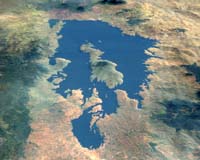
Kinshasa, DR Congo (AFP) April 4, 2007 With their recent agreement to extract methane gas from under Lake Kivu, one of Africa's Great Lakes, DR Congo and Rwanda hope not only to produce power but also to defuse a massive timebomb. "The reserves are currently estimated at around 55 billion cubic metres (two trillion cubic feet)," said Celestin Kasereka, researcher at nearby Goma's volcanic observatory. "The danger with the gas is that it is explosive when in a very strong concentration." Around two million people live around the lake. If the methane exploded, carbon dioxide -- denser than air -- would be released, killing tens of thousands of people, Kasereka believes. There is four times as much carbon dioxide under the lake as methane. Lake Kivu sits in an area of high volcanic activity, and a large flow of lava into its waters could cause an explosion, prompting a catastrophe, Kasereka said. When Mount Nyiragongo last erupted in 2002, the volcano spewed out 38 million cubic metres of lava, engulfing parts of the nearby city of Goma. "If a similar amount went directly into the lake, at high velocity, that could reach the deep waters and cause a gas explosion," Kasereka said. The resulting disaster would be even worse than when gas escaped from Lake Nyos in Cameroon in August 1986, Kasereka said, when carbon dioxide seeped out of the lake after an explosion and suffocated 1,800 people. Taking out the gas would reduce the risk, although the joint Kigali-Kinshasa project, signed on March 28, is not scheduled to be operational before 2009. The project could provide 500 megawatts of energy, supplying electricity to all those living around the 50-by-90-kilometre lake, said DRC's hydrocarbons minister Lambert Mende.
Source: Agence France-Presse Email This Article
Related Links
 Florida To Build Strongest Magnet Yet For Neutron Scattering Experiments
 Tallahassee FL (SPX) Apr 05, 2007
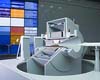
The Hahn-Meitner Institute in Berlin has contracted with the National High Magnetic Field Laboratory and Florida State University to build an $8.7-million hybrid magnet for "neutron scattering" experiments. When finished in 2011, the new, high-field magnet, which is based on the magnet lab's Series-Connected Hybrid concept, will be housed at the Berlin Neutron Scattering Center. |
|
|

| The content herein, unless otherwise known to be public domain, are Copyright 1995-2006 - SpaceDaily.AFP and UPI Wire Stories are copyright Agence France-Presse and United Press International. ESA PortalReports are copyright European Space Agency. All NASA sourced material is public domain. Additionalcopyrights may apply in whole or part to other bona fide parties. Advertising does not imply endorsement,agreement or approval of any opinions, statements or information provided by SpaceDaily on any Web page published or hosted by SpaceDaily. Privacy Statement |