| . |  |
. |
| . | |
. |


 by Staff Writers Bochum, Germany (SPX) Nov 19, 2018
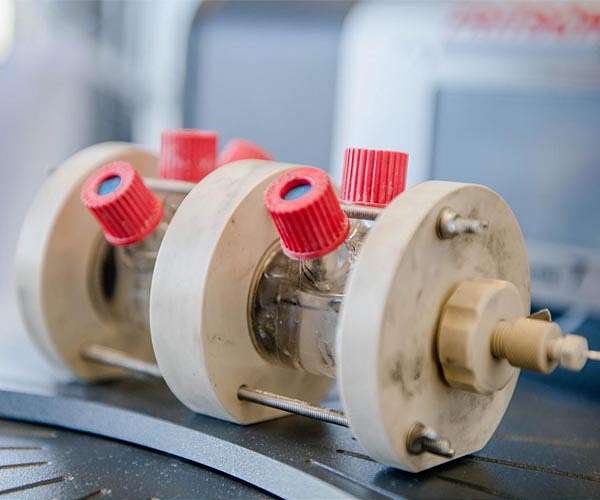
A catalyst for carbon dioxide recycling, Mineral pentlandite may also be a conceivable alternative to expensive precious metal catalysts. This is the result of a study conducted by researchers from Ruhr-Universitat Bochum (RUB), Fritz-Haber Institute Berlin and Fraunhofer Umsicht in Oberhausen. Pentlandite had previously been known as a catalyst for hydrogen production. By adding a suitable solvent, the researchers successfully utilised it to convert carbon dioxide into carbon monoxide. The latter is a common source material in the chemical industry. The research team headed by Dr. Ulf-Peter Apfel, Chair of Inorganic Chemistry I in Bochum, describes the findings together with their colleagues in the journal Chemical Science from 5 November 2018.
CO2 conversion replaces hydrogen production Moreover, potentially suitable catalysts primarily facilitate another chemical reaction, i.e. the synthesis of hydrogen - these including pentlandite. Nevertheless, the researchers have successfully converted the mineral to be a CO2 catalyst. They generated electrodes from pentlandite and analysed under which conditions production of hydrogen or carbon monoxide took place at their surface. "The decisive factor was water being present at the electrode surface," summarises Ulf-Peter Apfel. A lot of water shifted the reaction towards hydrogen production, a little water towards carbon monoxide production. By adjusting the water content, the researchers were thus able to generate carbon monoxide and hydrogen mixtures. "Synthetic gas mixtures like this one play a crucial role in the chemical industry," points out Apfel.
Stabile catalyst

Human excrement efficiently converted to hydrochar Beer-Sheva, Israel (SPX) Nov 16, 2018 Researchers from Ben-Gurion University of the Negev (BGU) demonstrated for the first time that raw human excrement can potentially be converted to a safe, reusable fuel and a nutrient rich fertilizer, solving two major worldwide issues in advance of World Toilet Day on November 19. According to the groundbreaking pilot study published in the Journal of Cleaner Production, researchers at BGU's Zuckerberg Institute for Water Research have refined a process using hydrothermal carbonization (HTC) to h ... read more
|
|||||||||||||
| The content herein, unless otherwise known to be public domain, are Copyright 1995-2026 - SpaceDaily. All websites are published in Australia and are solely subject to Australian law and governed by Fair Use principals for news reporting and research purposes. By using our websites you consent to cookie based advertising. If you do not agree with this then you must stop using the websites from May 25, 2018. Privacy Statement. Additional information can be found here at About Us. |

 del.icio.us
 Digg
Digg Reddit
 Google







