| . |  |
. |
| . | |
. |


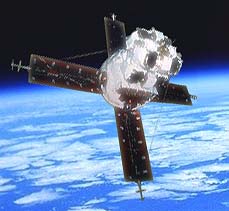
AeroAstro Completes Design Milestone For STPSat-1
Ashburn - July 17, 2002 AeroAstro, Inc., America's premier small satellite technology company, recently completed a successful Preliminary Design Review (PDR) of the STPSat-1 spacecraft, a $12 million contract awarded in September 2001 and funded through the Air Force Space Test Program Office at Kirtland Air Force Base (AFB) in Albuquerque, New Mexico. The PDR included reviews of the space vehicle system level architecture, subsystem level engineering, and mission operations. Customer feedback from the PDR was positive. Lt. Col. Perry Ballard of the Air Force Space Test Program Office at Kirtland Air Force Base said of the PDR, "The STPSat-1 PDR was well-conducted, highlighting the challenges and road ahead for this innovative project. As the first spacecraft designed to fly on the EELV Secondary Payload Adaptor, STP is expecting a lot and AeroAstro is stepping up to the plate very well." STPSat-1 offers a highly accurate three axis stabilized platform with 200+ Watts of orbit average power and better than 0.1 degree pointing accuracy in a 150 kg total spacecraft package. As prime contractor, AeroAstro is responsible for STPSat-1 spacecraft design and fabrication, integration of four Government-provided experiments, space vehicle testing, launch vehicle integration support and testing, launch and early orbit operations support, and one year of post-launch mission operations support. Pat Davis, AeroAstro's STPSat-1 Program Manager, commented, "AeroAstro is very pleased to successfully complete this first major milestone for the STPSat-1 program. Space vehicle design and technical analyses are progressing well, and the communication processes that have been established between the Air Force, AeroAstro, and our four experiment organizations are allowing us to finalize interfaces and proceed toward Critical Design Review this fall." The spacecraft design was based on low-risk design solutions and heritage components using an innovative system configuration to meet the challenges of the STPSat-1 mission. AeroAstro's partners in building STPSat-1 include Northrop Grumman TASC and Avidyne. The satellite is planned for launch in FY06 on a Delta-IV Medium Evolved Expendable Launch Vehicle (EELV) using the EELV Secondary Payload Adapter (ESPA) ring. AeroAstro, a pioneer of micro and nanospacecraft applications in science, remote sensing, and communications, is a leader in innovative small-satellite applications that open the space frontier to a larger and more varied constituency. It led the trend towards "smaller, faster, better, cheaper" spacecraft which became NASA's mantra with its highly successful ALEXIS satellite begun in 1988 and currently in its ninth year operating on-orbit. AeroAstro is now leading the way to a new age of commercial space with flexible tools that enable users to benefit from unprecedented access to space technology. AeroAstro has designed, constructed, tested, and supported the launch of several small satellites. It completed numerous spacecraft systems programs and manufactures low-cost satellite systems and components. NASA, the Air Force, and commercial and university customers have all employed AeroAstro throughout its 14-year history. Related Links AeroAstro SpaceDaily Search SpaceDaily Subscribe To SpaceDaily Express
 Object-Oriented Operational Architectures For Milspace
 McLean � July 16, 2002
SI International, an information technology (IT) and network solutions company, announced today that it has been selected as a contractor to the newly established Space Situational Awareness Integration Office (SSAIO). |
|
|

| The content herein, unless otherwise known to be public domain, are Copyright 1995-2006 - SpaceDaily.AFP and UPI Wire Stories are copyright Agence France-Presse and United Press International. ESA PortalReports are copyright European Space Agency. All NASA sourced material is public domain. Additionalcopyrights may apply in whole or part to other bona fide parties. Advertising does not imply endorsement,agreement or approval of any opinions, statements or information provided by SpaceDaily on any Web page published or hosted by SpaceDaily. Privacy Statement |