| . |  |
. |
| . | |
. |


 by Brooks Hays Washington (UPI) May 17, 2017
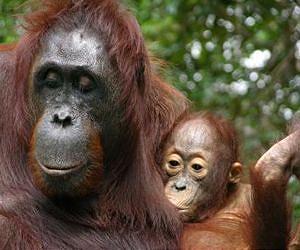
Maturing orangutan breastfeed for longer than any other mammal. New research suggests juvenile orangutan continue weaning for as many as eight or nine years. Scientists previously estimated orangutans breastfeed for seven years, but tracking nursing behavior in the wild is difficult. Biologists arrived at the new estimate -- shared in the journal Science Advances -- through a novel research technique. By measuring barium deposits in orangutan teeth, scientists were able to retrace dietary habits. Barium is a nonessential element absorbed in the teeth from breast milk during weaning. Researchers measured shifting barium levels in teeth belonging to four wild orangutans shot and killed several years ago in Borneo. The measurements suggests baby orangutan consume breast milk exclusively during the first year of life. Afterwards, the juveniles begin incorporate fruits and other food sources into their diet. However, barium levels suggests the apes continue to consume breast milk even in the eighth and ninth years of life, making orangutan the king of breastfeeding among apes. Chimps typically wean for five years and gorillas breastfeed for four. Humans are at the other end of the spectrum, breastfeeding for only two to three years -- much less than other primates. "That's what makes humans weird," Shara Bailey, a paleoanthropologist at New York University, told NPR. "And it's certainly one of the reasons why our population is so successful as a species." Anthropologists believe a shorter breastfeeding period allowed women to birth and raise more offspring, but researchers aren't sure exactly when humans adopted the abbreviated weaning schedule. Scientists hope to find answers by analyzing ancient human teeth the same way researchers studied orangutan enamel. "The potential is there to look now at Neanderthals, Homo erectus, Homo habilis, [and] Australopithicenes," Bailey said. "We can actually get an idea of when this very weird thing that characterizes humans occurred."
 Research suggests the ideal leader resembles his or her subordinates
Washington DC (UPI) May 16, 2017 New research suggests the ideal leader resembles their followers, or staff, in appearance. When researchers at the University of Exeter Business School and the Bradford University School of Management asked study participants to select photographs of an ideal leader, they found people had wildly divergent ideas about leadership is manifested in appearance. But when academics look ... read more Related Links All About Human Beings and How We Got To Be Here

|
|||||||||||||
| The content herein, unless otherwise known to be public domain, are Copyright 1995-2026 - SpaceDaily. All websites are published in Australia and are solely subject to Australian law and governed by Fair Use principals for news reporting and research purposes. By using our websites you consent to cookie based advertising. If you do not agree with this then you must stop using the websites from May 25, 2018. Privacy Statement. Additional information can be found here at About Us. |

 del.icio.us
 Digg
Digg Reddit
 Google






