| . |  |
. |
| . | |
. |


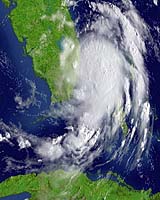
Active Atlantic Hurricane Season In 2006, But Fewer Landfalls
Miami (AFP) Dec 06, 2005 The current record Atlantic cyclone year will be followed by yet another highly active season, though Americans can expect fewer major hurricanes to make landfall in 2006, top experts said Tuesday. A total of 17 tropical storms, including nine hurricanes, should form in the Atlantic basin in 2006, as compared with a record-setting 26 tropical storms and 14 hurricanes this year, said leading experts William Gray and Philip Klotzbach of Colorado State University. Of those hurricanes, five should be intense, meaning they will reach or exceed category three on the five-level Saffir-Simpson scale, the forecasters said. Seven intense hurricanes formed in the Atlantic basin this year. The study said there was a 99 percent chance of a hurricane making landfall in the United States, with an 88 percent likelihood of a category one or two striking land, and an 81 percent chance of a category three, four or five slamming ashore. Other experts also have warned residents in threatened areas to brace for several more years of intense hurricane activity in the Atlantic. But there was good news for storm-weary residents of the southern United States, where four major hurricanes slammed ashore in 2004 and another four this year. "Even though we expect to see the current active period of major hurricane activity to continue for another 15-20 years, it is statistically unlikely that the coming 2006 and 2007 hurricane seasons, or the seasons that follow, will have the number of major hurricane US landfalls as we have seen in 2004-2005." Experts believe the latest record hurricane season was part of a cycle where periods of relative calm alternate with decades of intense activity. Some scientists also believe global warming plays a crucial effect by further increasing the temperature of warm ocean waters that provide fuel to the hurricanes. But the Colorado State University study played down the theory. "No credible observational evidence is available or likely will be available in the next few decades which will directly associate global surface temperature change to changes in global frequency and intensity." The hurricane season officially runs from June 1 to November 30, but Hurricane Epsilon on Tuesday still churned over the open ocean. A comparatively weak hurricane, with maximum sustained winds of 120 kilometers (75 miles) per hour, Epsilon was located 845 kilometers (525 miles) southwest of the Azores early Tuesday.
Source: Agence France-Presse Related Links SpaceDaily Search SpaceDaily Subscribe To SpaceDaily Express
 Volcano Leaves Up To 250,000 Without Water In Comoros
 Moroni (AFP) Dec 02, 2005
Up to 250,000 people on the main island of the Indian Ocean Comoros archipelago have been left without safe drinking water after last week's eruption of the Mount Karthala volcano, the United Nations said Saturday. |
|
|

| The content herein, unless otherwise known to be public domain, are Copyright 1995-2006 - SpaceDaily.AFP and UPI Wire Stories are copyright Agence France-Presse and United Press International. ESA PortalReports are copyright European Space Agency. All NASA sourced material is public domain. Additionalcopyrights may apply in whole or part to other bona fide parties. Advertising does not imply endorsement,agreement or approval of any opinions, statements or information provided by SpaceDaily on any Web page published or hosted by SpaceDaily. Privacy Statement |