| . |  |
. |
| . | |
. |


 by Staff Writers Chestnut Hill, MA (SPX) Oct 26, 2017
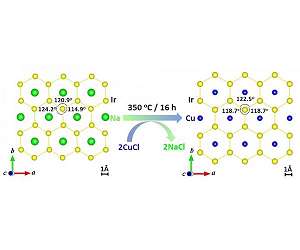
Researchers from Boston College and Harvard have created an elusive honeycomb-structured material capable of frustrating the magnetic properties within it in order to produce a chemical entity known as "spin liquid," long theorized as a gateway to the free-flowing properties of quantum computing, according to a new report in the Journal of the American Chemical Society. The first-of-its-kind copper iridate metal oxide - Cu2IrO3 - is one where the natural magnetic order is disrupted, a state known as geometric frustration, said Boston College Assistant Professor of Physics Fazel Tafti, a lead author of the study, titled Cu2IrO3: a new magnetically frustrated honeycomb iridate. The copper iridate is an insulator - its electrons are immobilized in the solid - but they can still transport a magnetic moment known as "spin". The transport of free spins in the material allows for a flow of quantum information. The Kitaev model, proposed in 2006 by Cal Tech Professor of Physics Alexei Kitaev, states that a hexagonal honeycomb structure offered a promising route to geometric frustration and therefore, to quantum spin liquid. Only two honeycomb lattice have been successfully developed in an attempt to fulfill Kitaev's model: a lithium iridate (Li2IrO3) and a sodium iridate (Na2IrO3). Yet both fell short of achieving an ideal spin liquid due to magnetic ordering, said Tafti, who co-authored the paper with Boston College post-doctoral researchers Mykola Abramchuk and Jason W. Krizan, BC Adjunct Professor of Chemistry and Director of Advanced Chemistry Laboratories Kenneth R. Metz, and Harvard's David C. Bell and Cigdem Ozsoy-Keskinbora. Tafti and his team turned to copper due to its ideal atomic size, which is between lithium and sodium. Their studies in x-ray crystallography found subtle flaws in the honeycombs formed in the lithium and sodium iridates. The team swapped copper for sodium in what Tafti termed a relatively simple "exchange" reaction. The effort produced the first oxide of copper and iridium, Tafti said. "Copper is ideally suited to the honeycomb structure," said Tafti. "There is almost no distortion in the honeycomb structure." A decade after the original prediction of quantum spin liquid on a honeycomb lattice by Kitaev, the young team of scientists from Boston College succeeded in making a material that almost exactly corresponds to the Kitaev model, Tafti said. Tafti's lab will pursue the "exchange" chemistry path to make new forms of honeycomb materials with more exotic magnetic properties, he said. Researchers from Boston College and Harvard have created an elusive honeycomb-structured material capable of frustrating the magnetic properties within it in order to produce a chemical entity known as "spin liquid," long theorized as a gateway to the free-flowing properties of quantum computing, according to a new report in the Journal of the American Chemical Society. The first-of-its-kind copper iridate metal oxide - Cu2IrO3 - is one where the natural magnetic order is disrupted, a state known as geometric frustration, said Boston College Assistant Professor of Physics Fazel Tafti, a lead author of the study, titled Cu2IrO3: a new magnetically frustrated honeycomb iridate. The copper iridate is an insulator - its electrons are immobilized in the solid - but they can still transport a magnetic moment known as "spin". The transport of free spins in the material allows for a flow of quantum information. The Kitaev model, proposed in 2006 by Cal Tech Professor of Physics Alexei Kitaev, states that a hexagonal honeycomb structure offered a promising route to geometric frustration and therefore, to quantum spin liquid. Only two honeycomb lattice have been successfully developed in an attempt to fulfill Kitaev's model: a lithium iridate (Li2IrO3) and a sodium iridate (Na2IrO3). Yet both fell short of achieving an ideal spin liquid due to magnetic ordering, said Tafti, who co-authored the paper with Boston College post-doctoral researchers Mykola Abramchuk and Jason W. Krizan, BC Adjunct Professor of Chemistry and Director of Advanced Chemistry Laboratories Kenneth R. Metz, and Harvard's David C. Bell and Cigdem Ozsoy-Keskinbora. Tafti and his team turned to copper due to its ideal atomic size, which is between lithium and sodium. Their studies in x-ray crystallography found subtle flaws in the honeycombs formed in the lithium and sodium iridates. The team swapped copper for sodium in what Tafti termed a relatively simple "exchange" reaction. The effort produced the first oxide of copper and iridium, Tafti said. "Copper is ideally suited to the honeycomb structure," said Tafti. "There is almost no distortion in the honeycomb structure." A decade after the original prediction of quantum spin liquid on a honeycomb lattice by Kitaev, the young team of scientists from Boston College succeeded in making a material that almost exactly corresponds to the Kitaev model, Tafti said. Tafti's lab will pursue the "exchange" chemistry path to make new forms of honeycomb materials with more exotic magnetic properties, he said.
 Understanding how electrons turn to glass
Sendai, Japan (SPX) Oct 26, 2017 Researchers at Tohoku University have gained new insight into the electronic processes that guide the transformation of liquids into a solid crystalline or glassy state. The ability of some liquids to transition into glass has been exploited since ancient times. But many fundamental aspects of this transition phase are far from understood. Better understanding could spur the development of ... read more Related Links Boston College Space Technology News - Applications and Research

|
|||||||||||||
| The content herein, unless otherwise known to be public domain, are Copyright 1995-2026 - SpaceDaily. All websites are published in Australia and are solely subject to Australian law and governed by Fair Use principals for news reporting and research purposes. By using our websites you consent to cookie based advertising. If you do not agree with this then you must stop using the websites from May 25, 2018. Privacy Statement. Additional information can be found here at About Us. |

 del.icio.us
 Digg
Digg Reddit
 Google





