24/7 Space News
SOLAR DAILY
A new protocol to enhance flexible solar technology durability
illustration only
A new protocol to enhance flexible solar technology durability
by Hugo Ritmico
Barcelona, Spain (SPX) Dec 04, 2024
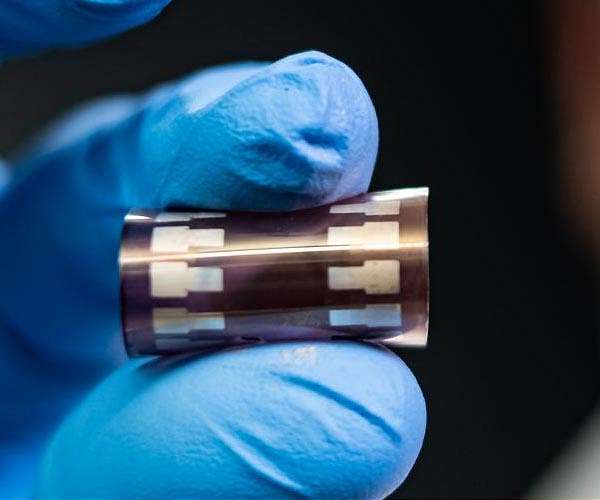
Flexible photovoltaic devices, or FlexPVs, are emerging as key solutions in applications ranging from wearable technology and smart textiles to drones and aerospace systems. Despite significant advancements in efficiency, FlexPVs still face challenges related to the lack of standardized testing protocols for durability and flexibility, hindering their practical adoption.

In response, the Universitat Rovira i Virgili (URV) has led an international team of 23 experts from 12 countries to develop a unified testing protocol for flexible solar cells and panels. The initiative, published in Nature Energy, focuses on mechanical performance, providing consistent metrics for evaluation. "The protocol measures efficiency over 1,000 bending cycles at a voltage of 1%, setting a benchmark for mechanical resistance," explained Lluis F. Marsal, a URV researcher in electronic, electrical, and automatic engineering.

This comprehensive method also assesses environmental factors such as humidity and temperature and incorporates encapsulation techniques to mitigate degradation. The protocol ensures these devices can perform effectively and safely in diverse conditions, enabling their use in applications requiring both flexibility and durability.

The research effort was co-led by Kenjiro Fukuda of the RIKEN Center for Emerging Matter Science in Saitama, Japan, and Osbel Almora, a researcher at URV and administrator of Emerging-PV.org. Marsal, a pioneer in organic solar cell research and leader of the URV Nanoelectronics and Photonic Systems group, also played a critical role in the project.

Expanding FlexPV Potential

Flexible photovoltaic devices distinguish themselves from rigid panels by using materials that allow adaptability to curved surfaces without significant efficiency loss. Their lightweight design makes them ideal for drones, smart clothing, wearable medical devices, and Internet of Things applications. The mechanical properties of FlexPVs enable resilience under extreme conditions, opening doors for use in aerospace and automotive technologies.

This new testing protocol represents the first step toward bridging the gap between photovoltaics and flexible electronics. "The progress of these devices will demand new protocols for testing stabilization, torsion, and adhesion properties, ensuring next-generation flexible solar cells meet future demands," Marsal concluded.

Research Report:A bending test protocol for characterizing the mechanical performance of flexible photovoltaics

Related Links
Universitat Rovira i Virgili
All About Solar Energy at SolarDaily.com

Subscribe Free To Our Daily Newsletters
Tweet

RELATED CONTENT
SOLAR DAILY
The future of AI with solar-powered synaptic devices
Tokyo, Japan (SPX) Nov 26, 2024
Artificial intelligence (AI) is increasingly relied upon for predicting critical events such as heart attacks, natural disasters, and infrastructure failures. These applications demand technologies capable of rapidly processing data. One such promising approach is reservoir computing, particularly physical reservoir computing (PRC), known for its efficiency in handling time-series data with minimal power consumption. Optoelectronic artificial synapses in PRC, mimicking human neural synaptic structures, ... read more

SOLAR DAILY
ISS crew members prepare space botany study and pack Dragon capsule for return

McGill Professor leads AXIS mission in final phase of NASA selection process

NASA Voyager 1 returns to full operations after communication issue

Slingshot Aerospace secures $13M NOAA contract for Space Traffic Platform Interface

SOLAR DAILY
SpaceX reaches milestone with 300th successful booster landing

ESA launches spacecraft that will eventually create artificial solar eclipse

Europe's troubled Vega-C rocket launches after delays

Vega-C set for launch marking its return to service

SOLAR DAILY
China's Tianwen-1 probe reveals new insights into Martian internal gravity waves

Mars Ocean Analogs Completes Winter Solstice Voyage and Plans Future Expeditions

China aims to return Mars samples to Earth by 2031

Scientists map complete energy spectrum of solar high-energy protons near Mars

SOLAR DAILY
Long March 12 set for inaugural launch from Hainan space center

China inflatable space capsule aces orbital test

Tianzhou 7 completes cargo Mission, Tianzhou 8 docks with Tiangong

Zebrafish thrive in space experiment on China's space station

SOLAR DAILY
AST SpaceMobile teams with Cadence to drive space-based cellular broadband

Parsons and Globalstar demonstrate first software-defined LEO satellite solution

Losses in 2024 cyclone season unusually high: Munich Re

Veteran Ventures Capital invests in Turion Space to drive advanced space technology

SOLAR DAILY
A new way to create realistic 3D shapes using generative AI

Speaking crystal AI predicts atomic arrangements to aid material discovery

Scientists explore sustainable use of fly ash for water treatment

Cracking the Code for materials that can learn

SOLAR DAILY
Unveiling a hydrogen-controlled nano-switch in electron transport proteins

Final data and undiscovered images from NASA's NEOWISE

Team identifies how interstellar medium impacts pulsar signals

Discovery Alert: a 'Hot Neptune' in a Tight Orbit

SOLAR DAILY
Magnetic tornado is stirring up the haze at Jupiter's poles

Uranus moons could hold clues to hidden oceans for future space missions

A clue to what lies beneath the bland surfaces of Uranus and Neptune

Europa Clipper deploys instruments on journey to icy moon of Jupiter


The content herein, unless otherwise known to be public domain, are Copyright 1995-2026 - SpaceDaily.com. All websites are published in Australia and are solely subject to Australian law and governed by Fair Use principals for news reporting and research purposes. AFP, UPI and IANS news wire stories are copyright Agence France-Presse, United Press International and Indo-Asia News Service. ESA news reports are copyright European Space Agency. All NASA sourced material is public domain. Additional copyrights may apply in whole or part to other bona fide parties. All articles labeled "by Staff Writers" include reports supplied to Space Media Network by industry news wires, PR agencies, corporate press officers and the like. Such articles are individually curated and edited by Space Media Network staff on the basis of the report's information value to our industry and professional readership. Advertising does not imply endorsement, agreement or approval of any opinions, statements or information provided by Space Media Network on any Web page published or hosted by Space Media Network. General Data Protection Regulation (GDPR) Statement Our advertisers use various cookies and the like to deliver the best ad banner available at one time. All network advertising suppliers have GDPR policies (Legitimate Interest) that conform with EU regulations for data collection. By using our websites you consent to cookie based advertising. If you do not agree with this then you must stop using the websites from May 25, 2018. Privacy Statement. Additional information can be found here at About Us.
Subscribe Free To Our Daily Newsletters