| . |  |
. |
| . | |
. |


 by Staff Writers Helsinki, Finland (SPX) Apr 22, 2018
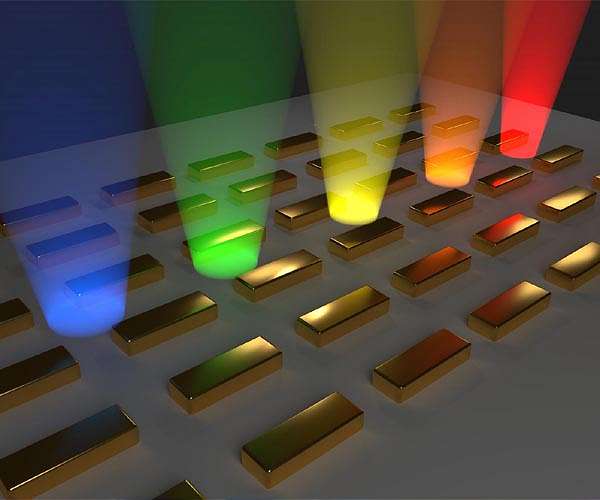
Nearly a hundred years ago, Albert Einstein and Satyendra Nath Bose predicted that quantum mechanics can force a large number of particles to behave in concert as if they were only a single particle. The phenomenon is called Bose-Einstein condensation, and it took until 1995 to create the first such condensate of a gas of alkali atoms. Although Bose-Einstein condensation has been observed in several systems, the limits of the phenomenon need to be pushed further: to faster timescales, higher temperatures, and smaller sizes. The easier creating these condensates gets, the more exciting routes open for new technological applications. New light sources, for example, could be extremely small in size and allow fast information processing. In experiments by Aalto researchers, the condensed particles were mixtures of light and electrons in motion in gold nanorods arranged into a periodic array. Unlike most previous Bose-Einstein condensates created experimentally, the new condensate does not need to be cooled down to temperatures near absolute zero. Because the particles are mostly light, the condensation could be induced in room temperature. 'The gold nanoparticle array is easy to create with modern nanofabrication methods. Near the nanorods, light can be focused into tiny volumes, even below the wavelength of light in vacuum. These features offer interesting prospects for fundamental studies and applications of the new condensate,' says Academy Professor Paivi Torma. The main hurdle in acquiring proof of the new kind of condensate is that it comes into being extremely quickly.'According to our theoretical calculations, the condensate forms in only a picosecond,' says doctoral student Antti Moilanen. 'How could we ever verify the existence of something that only lasts one trillionth of a second?'
Turning distance into time 'As the condensate takes form, it will emit light throughout the gold nanorod array. By observing the light, we can monitor how the condensation proceeds in time. This is how we can turn distance into time,' explains staff scientist Tommi Hakala. The light that the condensate emits is similar to laser light. 'We can alter the distance between each nanorod to control whether Bose-Einstein condensation or the formation of ordinary laser light occurs. The two are closely related phenomena, and being able to distinguish between them is crucial for fundamental research. They also promise different kinds of technological applications,' explains Professor Torma. Both lasing and Bose-Einstein condensation provide bright beams, but the coherences of the light they offer have different properties. These, in turn, affect the ways the light can be tuned to meet the requirements of a specific application. The new condensate can produce light pulses that are extremely short and may offer faster speeds for information processing and imaging applications. Academy Professor Torma has already obtained a Proof of Concept grant from the European Research Council to explore such prospects.
Research Report: "Bose-Einstein Condensation in a Plasmonic Lattice"
Course set to overcome mismatch between lab-designed nanomaterials and nature's complexity Washington DC (SPX) Apr 22, 2018 Cells and the machinery they encase are soft matter - shape-shifting multicomponent systems with an overwhelming richness of forms. But, these squishy packages are hard targets for potential therapeutic and diagnostic applications that exploit nanomaterials, from quantum dots that light up specific tissues to nanocages carrying drug payloads. The problem, according to a team of 12 experts from five countries, stems from a "mismatch" between the structural complexity that nature selected over billi ... read more
|
|||||||||||||
| The content herein, unless otherwise known to be public domain, are Copyright 1995-2026 - SpaceDaily. All websites are published in Australia and are solely subject to Australian law and governed by Fair Use principals for news reporting and research purposes. By using our websites you consent to cookie based advertising. If you do not agree with this then you must stop using the websites from May 25, 2018. Privacy Statement. Additional information can be found here at About Us. |

 del.icio.us
 Digg
Digg Reddit
 Google







