| . |  |
. |
| . | |
. |


 by Staff Writers Zurich, Switzerland (SPX) Feb 17, 2016
According to the World Health Organisation (WHO), around 15% of the world's population is physically impaired to some degree. In order to overcome the hurdles of everyday life, many disabled people use assistive technologies. Unfortunately, technology has not kept pace - most wheelchairs cannot yet climb stairs, bulky powered exoskeletons lack acceptance, and prostheses are still limited in function. This week during the AAAS 2016 Annual Meeting in Washington D.C., Robert Riener from ETH Zurich, The Swiss Federal Institute of Technology in Zurich, Switzerland, Ronald Triolo, Case Western Reserve University in Cleveland, Ohio, U.S.A., and Kyu Jin Cho, Seoul National University in Seoul, Republic of Korea reveal the latest developments in limb prosthetics, assistive robotics, and brain computer interfaces that tackle form as well as function. In the future, artificial electrical stimulation signals will stimulate nerves and glove-like soft devices will restore hand functions offering a better quality of life for people who need assistive devices.
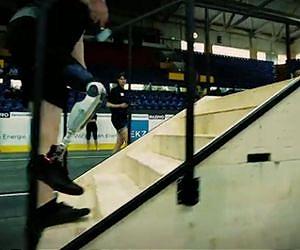
Challenging the Scientific Community to Advance Assistive Technologies It is comprised of different disciplines that test the ability of pilots to navigate a series of everyday tasks while using assistive devices and robotic technologies. Riener founded the Cybathlon event as a platform for developing and benchmarking novel assistive technologies useful for the daily life of persons with motor disabilities. The well-defined race tracks, normed obstacles and exact rules will make it possible to compare the performance of devices in a relevant setting. Six different disciplines apply the most modern powered devices such as prostheses, wearable exoskeletons, wheelchairs, functional electrical stimulation as well as novel brain-computer interfaces. Cybathlon 2016 will be held in Zurich, Switzerland on October 8th, 2016
Implanted Neuroprostheses for Mobility after Paralysis He will demonstrate a novel adaptation of implanted technologies by interfacing them with exercise equipment. This system presents a new option for recreation and independence previously unavailable to implanted neuroprosthesis recipients and offers potential health benefits derived from exercising the large paralyzed muscles of the lower extremities and trunk. Exo-Glove: Technology that Enables People with Hand Disabilities to Grasp Kyu Jin Cho, Director of the Biorobotics Laboratory at Seoul National University in South Korea introduces the Exo-glove that addresses paralysis of the hand that inhibits patients from even the most simple of activities in daily life. The Exo-glove is a hand robot inspired by human fingers and superior to exoskeletons due to its light-weight compactness and increased usability. The robotic technology enables people with spinal cord injuries to grasp objects of various shapes - potentially improving their quality of life. The device is developed through a unique and inspiring cooperation of students with disabled persons.
Related Links ETH Zurich All about the robots on Earth and beyond!
|
|||||||||||||
| The content herein, unless otherwise known to be public domain, are Copyright 1995-2026 - SpaceDaily. All websites are published in Australia and are solely subject to Australian law and governed by Fair Use principals for news reporting and research purposes. By using our websites you consent to cookie based advertising. If you do not agree with this then you must stop using the websites from May 25, 2018. Privacy Statement. Additional information can be found here at About Us. |


 del.icio.us
 Digg
Digg Reddit
 Google