. 24/7 Space News .
FLORA AND FAUNA
A changing season means a changing diet for bison
by Staff Writers
Boulder CO (SPX) Nov 27, 2015


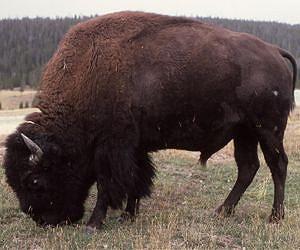
An American bison grazing. Image courtesy J Schmidt and NPS. For a larger version of this image please go here.

North American bison adjust their diet seasonally in order to take full advantage of the growing season when grasses become less nutritious, a new study led by researchers at the University of Colorado Boulder has discovered.

The findings, which were recently published in the journal PLOS ONE, indicate that bison are not entirely reliant on grass for their nutritional needs and can selectively expand their foraging to include woody shrubs and flowering plants during the spring and fall.

The study sheds new light on variations in the large herbivore's eating habits and may have future implications for management and conservation of bison in Colorado and across the American West.

"We wanted to know if bison might change what they eat as the season goes on and how that affects the microbial composition of their gut," said Gaddy Bergmann, a doctoral candidate in the Department of Ecology and Evolutionary Biology at CU-Boulder.

"This study shows that it may be beneficial for the species to have other plants, bushes, and trees available to browse from."

The 166-day study conducted in 2011 sampled a herd of roughly 300 bison living in the Konza Prairie Biological Station in the Flint Hills area of northern Kansas. Bison were reintroduced to the protected native tallgrass sanctuary in 1987.

By sequencing the plant and bacterial DNA found in the bison's fecal samples, researchers at CU-Boulder were able to identify the types of plants that the bison were consuming over time.

The researchers found that the bison are willing and able to consume higher quantities of woody shrubs in the early spring and in fall when their preferred menu item--fresh grass--is less available.

The researchers then identified benign gut microbes present in the bison's lower digestive tract and traced how the abundance of those microbes changed over time. Some bacteria became more abundant during the growing season as the bison switched to more energy-rich foods in the summer and autumn.

Other grazing animals throughout the world, such as elk and wildebeests, migrate over long distances in order to follow their food supply. Historically, bison did so as well, but are more sedentary in their range today, making them more susceptible to seasonal changes in vegetation.

While an estimated 20 to 30 million bison once roamed the North American landscape, hunting and habitat encroachment reduced the population to just a few thousand by the end of the 1800s.


Thanks for being here;
We need your help. The SpaceDaily news network continues to grow but revenues have never been harder to maintain.

With the rise of Ad Blockers, and Facebook - our traditional revenue sources via quality network advertising continues to decline. And unlike so many other news sites, we don't have a paywall - with those annoying usernames and passwords.

Our news coverage takes time and effort to publish 365 days a year.

If you find our news sites informative and useful then please consider becoming a regular supporter or for now make a one off contribution.
SpaceDaily Contributor
$5 Billed Once


credit card or paypal
SpaceDaily Monthly Supporter
$5 Billed Monthly


paypal only


.


Related Links
University of Colorado at Boulder
Darwin Today At TerraDaily.com


Comment on this article via your Facebook, Yahoo, AOL, Hotmail login.

Share this article via these popular social media networks
del.icio.usdel.icio.us DiggDigg RedditReddit GoogleGoogle

Previous Report
FLORA AND FAUNA
When every species counts
Leipzig, Germany (SPX) Nov 27, 2015
The relationship between biodiversity and ecosystem functioning greatly depends on the prevalent environmental conditions. An interdisciplinary team consisting of microbiologists and ecological modellers from the Helmholtz Centre for Environmental Research (UFZ) and the Stockholm Resilience Centre has now tested this hypothesis which is considered crucial for biodiversity research. Through ... read more


FLORA AND FAUNA
Gaia's sensors scan a lunar transit

SwRI scientists explain why moon rocks contain fewer volatiles than Earth's

All-female Russian crew starts Moon mission test

Russian moon mission would need 4 Angara-A5V launches

FLORA AND FAUNA
Study: Mars to become a ringed planet following death of its moon

A witness to a wet early Mars

NASA completes heat shield testing for future Mars exploration vehicles

Curiosity Mars Rover Heads Toward Active Dunes

FLORA AND FAUNA
XCOR develops Lynx Simulator

Orion ingenuity improves manufacturing while reducing mass

Orion's European module ready for testing

General Dynamics demos SGSS Command and Control Infrastructure for NASA

FLORA AND FAUNA
China to launch Dark Matter Satellite in mid-December

China to better integrate satellite applications with Internet

China's satellite expo opens

New rocket readies for liftoff in 2016

FLORA AND FAUNA
ISS EarthKAM ready for student imaging request

Partners in Science: Private Companies Conduct Valuable Research on the Space Station

SAGE III Leaves Langley for Journey to ISS

New Crew to Stay Aboard ISS for 7 Months Instead of 6

FLORA AND FAUNA
NASA Orders SpaceX Crew Mission to International Space Station

NASA Selects New Technologies for Parabolic Flights and Suborbital Launches

United Launch Alliance exits launch competition, leaving SpaceX

Spaceport America opens up two new campuses

FLORA AND FAUNA
Forming planet observed for first time

UA researchers capture first photo of planet in making

Rocket Scientists to Launch Planet-Finding Telescope

5400mph winds discovered hurtling around planet outside solar system

FLORA AND FAUNA
Creating a new vision for multifunctional materials

3-D printing aids in understanding food enjoyment

Success in producing a completely rare-earth free Feni magnet

Bringing the chaos in light sources under control


The content herein, unless otherwise known to be public domain, are Copyright 1995-2026 - SpaceDaily. All websites are published in Australia and are solely subject to Australian law and governed by Fair Use principals for news reporting and research purposes. By using our websites you consent to cookie based advertising. If you do not agree with this then you must stop using the websites from May 25, 2018. Privacy Statement. Additional information can be found here at About Us.