| . |  |
. |
| . | |
. |


A Deep Sea Hydrocarbon Factory
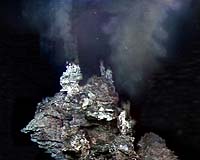
Minneapolis MN (SPX) Dec 13, 2004 A team of University of Minnesota scientists has discovered how iron- and chromium-rich rocks can generate natural gas (methane) and related hydrocarbons when reacted with superheated fluids circulating deep beneath the floor of the Atlantic Ocean. Because the process is completely nonbiological, the hydrocarbons could have been a source of "food" for some of the first organisms to inhabit the Earth. Also, methane is a potent greenhouse gas, and this process may have contributed to global warming early in geologic time, the researchers said. The researchers - Dionysios Foustoukos and Fu Qi and their graduate adviser, professor W.E. Seyfried, Jr.- presented a portion of this work on Monday, Dec. 13, at the American Geophysical Union meeting in the Moscone Convention Center, San Francisco. The most familiar sources of methane are bacteria that live in bogs, lakes and the stomachs of ruminants like cows. But before any life existed, there must have been an energy source that could be tapped by primitive life forms. The simplest sources are hydrogen-rich compounds like hydrogen gas, hydrogen sulfide gas and hydrocarbons. In the laboratory, the researchers recreated the intense heat (more than 700 degrees F) and pressure (400 times air pressure at sea level) that exist on the ocean bottom in parts of the Mid-Atlantic Ridge (MAR). The MAR, which runs in a jagged north-south line beneath the Atlantic Ocean, is a site where upwelling magma is slowly pushing huge slabs of crust apart, exposing portions of the Earth's upper mantle. It contains structures called hydrothermal (hot water) vents, which spew superheated fluids into the seawater. The team found that under such conditions, hydrocarbons - methane, ethane and propane - could be produced on the surface of minerals rich in iron and chromium.These hydrocarbons may help account for the diverse communities of life that typically thrive around hydrothermal vents. The process of hydrocarbon production occurs in two steps. In the first, an iron compound in rock strips water of its oxygen, liberating hydrogen gas. In the second step, hydrogen gas and carbon dioxide (from the degassing of magma) combine to produce methane and water. The Minnesota team discovered that rocks rich in chromium minerals accelerate the second step, while also producing more complex hydrocarbons - ethane and propane. Both likely serve as food for some bacteria. "The second step is a reaction well known to chemists," said Seyfried, a professor of geology and geophysics. "But in several papers published in the last few years, researchers have noted great difficulty in forming hydrocarbons more complex than methane. Dionysios [Foustoukas] showed that in the presence of chromium-bearing minerals, it could happen. "Chemists might want to tweak this process and see if they can produce hydrocarbons more efficienty. But we want to get clues about what goes on in hydrothermal vents and to understand how hydrocarbon gases are generated in the continental and oceanic crust." In related work, Seyfried and and his colleague Kang Ding have built chemical sensors that can be placed in hydrothermal vents to measure such items as acidity and the amounts of gases like hydrogen and hydrogen sulfide, which also serve as energy sources for microbial communities. Acidity also seems to play a role in hydrocarbon synthesis in submarine hydrothermal systems. To access the vents as deep as two miles beneath the sea surface, the researchers use the submersible ALVIN; they have now dived to a number of vent sites. Related Links University of Minnesota SpaceDaily Search SpaceDaily Subscribe To SpaceDaily Express
 Putting Earth In Rehab
 University Park PA (SPX) Dec 10, 2004
The length of time necessary to recover from a mass extinction may seem like a problem from the past, but a team of Penn State researchers is investigating recovery from the second largest extinction in Earth's history at the end of the Ordovician 443 million years ago and sees some parallels to today's Earth. |
|
|

| The content herein, unless otherwise known to be public domain, are Copyright 1995-2006 - SpaceDaily.AFP and UPI Wire Stories are copyright Agence France-Presse and United Press International. ESA PortalReports are copyright European Space Agency. All NASA sourced material is public domain. Additionalcopyrights may apply in whole or part to other bona fide parties. Advertising does not imply endorsement,agreement or approval of any opinions, statements or information provided by SpaceDaily on any Web page published or hosted by SpaceDaily. Privacy Statement |