| . |  |
. |
| . | |
. |


 by Staff Writers Pasadena CA (JPL) Mar 12, 2018
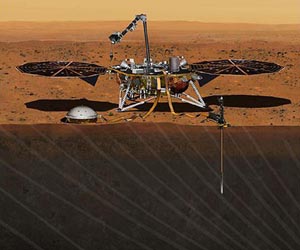
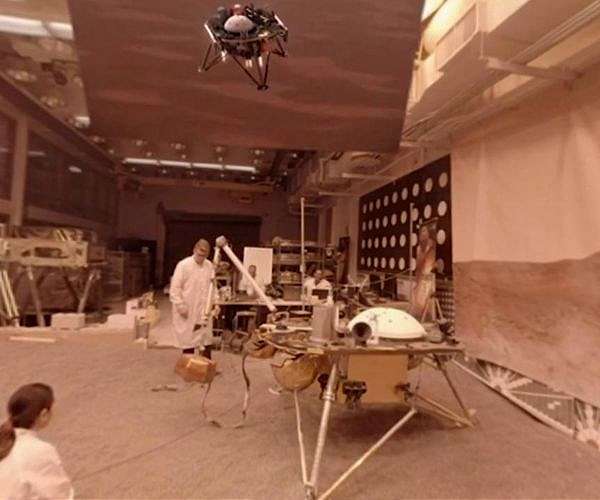
NASA's InSight lander looks a bit like an oversized crane game: when it lands on Mars this November, its robotic arm will be used to grasp and move objects on another planet for the first time. And like any crane game, practice makes it easier to capture the prize. Engineers and scientists have a replica of InSight at NASA's Jet Propulsion Laboratory in Pasadena, California. They use this testbed to simulate all the functions of the spacecraft, preparing for any scenario it might meet once it touches down on the Red Planet. InSight is unique in that it's a lander rather than a rover; once it touches down, it can't reposition itself. Its job is to stay very still and collect high-precision data. JPL's testbed for the lander sits on piles of crushed garnet in a facility called the In-Situ Instrument Lab. This garnet simulates a mix of sand and gravel found on the Martian surface but has the benefit of being dust-free. The testbed's legs are raised or lowered to test operations in an uneven landing area with up to 15 degrees of tilt. Engineers also pile garnet at different tilts in the testbed's "workspace" - the area in front of the lander where it practices setting down three science tools: an ultra-sensitive seismometer; a shield that isolates the seismometer from wind and temperature swings; and a heat-flow probe. These three objects are formally called the Science Experiment for Interior Structure (SEIS); the Wind and Thermal Shield (WTS); and the Heat Flow and Physical Properties Probe (HP3). All this practice ensures InSight can set these objects down safely no matter what surprises its landing site has in store. One challenge lies in the tethers that supply power to each science instrument, said Marleen Sundgaard of JPL, InSight's testbed lead. Each tether unspools as the arm lifts an instrument off the lander. "We have multiple places where we could put each instrument down," Sundgaard said. "There are scenarios where the tethers would cross each other, so we need to make sure they don't snag." Besides robotic operations, the testbed has to recreate Martian light. Special lights are also used to calibrate InSight's cameras to the brightness and color of Martian sunlight. All this practice should pay off with some incredible new science. InSight will be the first mission dedicated to exploring the deep interior of Mars, including its core and mantle. The data it collects could help scientists understand how all rocky planets - including Mars and Earth - first formed. InSight will launch from Vandenberg Air Force Base in central California. The launch window opens on May 5.
Seven ways Mars InSight is different Pasadena CA (JPL) Feb 23, 2018 NASA's Mars InSight lander team is preparing to ship the spacecraft from Lockheed Martin Space in Denver, where it was built and tested, to Vandenberg Air Force Base in California, where it will become the first interplanetary mission to launch from the West Coast. The project is led by NASA's Jet Propulsion Laboratory in Pasadena, California. NASA has a long and successful track record at Mars. Since 1965, it has flown by, orbited, landed and roved across the surface of the Red Planet. What can I ... read more
|
|||||||||||||
| The content herein, unless otherwise known to be public domain, are Copyright 1995-2026 - SpaceDaily. All websites are published in Australia and are solely subject to Australian law and governed by Fair Use principals for news reporting and research purposes. By using our websites you consent to cookie based advertising. If you do not agree with this then you must stop using the websites from May 25, 2018. Privacy Statement. Additional information can be found here at About Us. |

 del.icio.us
 Digg
Digg Reddit
 Google







