| . |  |
. |
| . | |
. |


 by Staff Writers Mainz, Germany (SPX) Jan 28, 2022
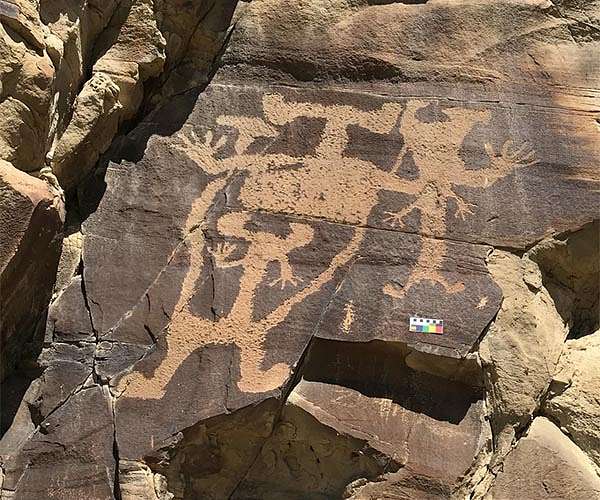
To reliably estimate the age of the figures carved into the rocks, the scientists determined the mass per area, or areal density, of manganese and iron on the rock surface. Both elements are part of the crust called rock varnish, which was deposited on rocks as a thin, dark coating. After carving, this layer forms again on the petroglyphs and grows over the years. "We compared intact rock varnish with the varnish of the engravings and were thus able to classify them chronologically," explains Meinrat O. Andreae. Together with his wife, biogeoscientist Tracey W. Andreae, the director emeritus of the Mainz Institute conducted a total of 461 measurements directly on site using a portable X-ray fluorescence device. Importantly, the rock varnish is not destroyed or damaged by the measurements.
Four sites in Idaho, Wyoming, and southern Montana Moreover, the scientists were able to complement their own method with measurements of rock engravings whose ages had previously been dated using independent geochemical methods. Both age estimates were in excellent agreement and thus confirmed each other. The comparison with other archaeological material at the rock art sites, which had been previously dated, also supported the researchers' age estimates.
Linear, constant deposition rates of manganese in the rock varnish To substantiate this hypothesis, they conducted analyses of rock surfaces for which there is no doubt as to when they were formed. In the Great Basin, two types of surfaces comply with this condition: The melon-shaped basalt boulders in the Snake River valley that were geologically abraded 14,500 years ago, and two circa 2,000-year-old basalt lava flows in the Craters of the Moon National Monument. In fact, deposition rates were nearly constant at both times, suggesting a roughly linear deposition. "All of our analyses suggest that the earliest petroglyphs were created as early as the transition period from the Pleistocene to the Holocene, about 12,000 years ago, and were repeatedly revised by indigenous people over thousands of years until the recent past," explains Andreae, a biogeochemist. At Celebration Park alone, one of the Idaho sites, rock engravings cover a span of about 10,000 years. The earliest images there were abstract forms. Later, representational images were added. At other sites, again, representational figures dominated first and abstract patterns followed later.
Broad spectrum of styles and motifs "Our method provides a link between the natural and human sciences. It enables age estimates for a statistically relevant, large number of rock art elements - with modest effort and, above all, without the need for destructive sampling," says Andreae, summing up the results of the study in the North American Basin. The Max Planck researcher is already planning further expeditions to Saudi Arabia, where there are also numerous well-preserved petroglyphs.
Research Report: "Archaeometric studies on rock art at four sites in the northeastern Great Basin of North America"

23,000 years ago, humans in Israel enjoyed a new bounty of food options Jerusalem (SPX) Jan 27, 2022 As climate shifted 23,000 years ago, humans in Israel experienced a new abundance of food, according to a study published January 26, 2022 in the open-access journal PLOS ONE by Tikvah Steiner of the Hebrew University of Jerusalem and colleagues. The submerged archaeological site of Ohalo II, located on the southern tip of the Sea of Galilee in Israel, preserves extensive evidence of human occupation about 23,000 years ago. This was a time period of global climate fluctuation, and also a time when ... read more
|
|||||||||||||
| The content herein, unless otherwise known to be public domain, are Copyright 1995-2026 - SpaceDaily. All websites are published in Australia and are solely subject to Australian law and governed by Fair Use principals for news reporting and research purposes. By using our websites you consent to cookie based advertising. If you do not agree with this then you must stop using the websites from May 25, 2018. Privacy Statement. Additional information can be found here at About Us. |

 del.icio.us
 Digg
Digg Reddit
 Google







