|
 |
 |
 |
 |
 |
 |
 |
 |
 |

| . |  |
. |
Boeing Delta-4 To Launch DSCS-3 A3 Satellite For US Air Force
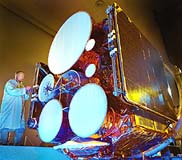
Boeing officials today announced the U.S. Air Force has assigned a second launch of a Defense Satellite Communications System (DSCS) satellite aboard a Boeing Delta IV rocket. The DSCS III A3 satellite will be deployed by a Boeing Delta IV Medium expendable launch vehicle. The launch is scheduled for the second quarter of 2003 from Cape Canaveral Air Force Station, Florida. "The selection by the Air Force to launch another DSCS satellite on our Delta IV expresses continued confidence by the Air Force in the Delta IV program," said Tom Parkinson, division director of U.S. government sales for Boeing Delta Launch Services. "Having launched numerous national security payloads for the government aboard our Delta II, we continue to extend our launch services to our Delta IV vehicles." The Boeing Delta IV Medium is a single common booster core launch vehicle with a 4-meter fairing and is capable of lifting approximately 9,285 pounds (4,210 kg) to geosynchronous transfer orbit. "We're very pleased with the great job Boeing has done integrating our first DSCS III/Delta IV mission," said Col. Robert Saxer, U.S. Air Force Evolved Expendable Launch Vehicle system program director. "The Boeing Delta team has also made tremendous progress bringing the Delta IV and its new RS-68 main engine to the international marketplace." The U.S. Air Force Space Command operates 10 Phase III DSCS satellites providing defense officials and battlefield commanders secure voice and high rate data communications. The DSCS III system also transmits space operations and early warning data to various systems and users. Boeing has sold out all four launches of the Delta IV in 2002, and is 50 percent sold out for 2003. First flight of the Delta IV is scheduled for Spring of 2002. Related Links Defense Satellite Communications System at FAS SpaceDaily Search SpaceDaily Subscribe To SpaceDaily Express  Milstar Launch Into GEO A Success
 Cape Canaveral - Feb. 28, 2001
A Titan IV-B has successfully launched a USAF Milstar satellite into orbit. After three burns over a six-and-a-half-hour-period, the Centaur upper stage delivered the satellite to its intended orbit 22,300 miles above the equator.
|
|
| |||||||||
| The content herein, unless otherwise known to be public domain, are Copyright 1995-2016 - Space Media Network. All websites are published in Australia and are solely subject to Australian law and governed by Fair Use principals for news reporting and research purposes. AFP, UPI and IANS news wire stories are copyright Agence France-Presse, United Press International and Indo-Asia News Service. ESA news reports are copyright European Space Agency. All NASA sourced material is public domain. Additional copyrights may apply in whole or part to other bona fide parties. Advertising does not imply endorsement, agreement or approval of any opinions, statements or information provided by Space Media Network on any Web page published or hosted by Space Media Network. Privacy Statement All images and articles appearing on Space Media Network have been edited or digitally altered in some way. Any requests to remove copyright material will be acted upon in a timely and appropriate manner. Any attempt to extort money from Space Media Network will be ignored and reported to Australian Law Enforcement Agencies as a potential case of financial fraud involving the use of a telephonic carriage device or postal service. |