|
 |
 |
 |
 |
 |
 |
 |
 |
 |

| . |  |
. |
Milstar Launch Into GEO A Success
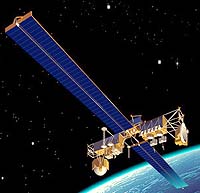
The U.S. Air Force successfully launched a Titan IV-B rocket carrying a Milstar satellite from Space Launch Complex 40 at Cape Canaveral Air Station, Fla. on Wendesday at 4:20pm (EST). After three burns over a six-and-a-half-hour-period, the Centaur upper stage delivered the satellite to its intended orbit 22,300 miles above the equator. The Centaur and the satellite were under the control of the 50th Space Wing at Schriever AFB, Colo. "The satellite is performing as expected," the Milstar satellite program manager Col. Greg Miller said from Schriever AFB. He added that after a 120-day checkout period the satellite will begin providing critical communications to U.S. military forces around the world. "It was a beautiful flight. All the members of our Titan team can be justifiably proud of the fact that we launched a satellite that will extend America's global reach, global power and global vigilance," said launch director Lt. Col. Dave Jones, commander of the 3rd Space Launch Squadron. With the Titan IV-B rocket nicknamed "Gus," this launch marked the symbolic return to flight of Lt. Col. Virgil "Gus" Grissom. Members of the 45th Space Wing's launch squadrons often nickname the boosters after space pioneers or icons. "He was one of the original Mercury 7 and the first Air Force astronaut to fly," said Capt. Reece Stephenson, of the 45th Operations Support Squadron. "That's why I nicknamed the Titan booster after him." Milstar is a joint service satellite communications system that will provide secure, jam resistant worldwide communications to meet the essential wartime requirements for high priority military users. The multi-satellite constellation will link command authorities with a wide variety of resources, including ships, submarines, aircraft and ground stations. Each Milstar satellite serves as a smart "switchboard" in space by directing traffic from terminal to terminal anywhere on the Earth. "I call it the FedEx of communications systems. When it absolutely, positively has to be there, Milstar is the system," said Brig. Gen. Craig Cooning, the Air Force's program executive officer for space. He served as the satellite control authority for this mission. "We had an outstanding joint Air Force, industry team that worked very, very hard for this success," said Mission Director Col. Mike Dunn, director of the Launch Programs Directorate at SMC. The Titan IV-B/Milstar launch team encompasses many agencies such as: 45th Space Wing and its 3rd Space Launch Squadron, Cape Canaveral AFS; the Space and Missile Systems Center, Los Angeles AFB, Calif. and its Detachment 8, Cape Canaveral AFS; Lockheed Martin Space Systems Company, Denver, Colo. and Sunnyvale, Calif.; The Aerospace Company, Cape Canaveral AFS; TRW Space and Electronics Group, Redondo Beach, Calif.; and Boeing Satellite Systems, Inc., Los Angeles, Calif. Related LinksMilstar Flight 4 News Center SpaceDaily Search SpaceDaily Subscribe To SpaceDaily Express  Boeing To Build 11th UHF Follow-On Satellite
 El Segundo - Jan. 8, 2001
The U.S. Navy has authorized Boeing Satellite Systems Inc. (BSS) to begin production of the 11th in a series of UHF Follow-On (UFO) satellites, which provide global communications for the armed forces. BSS is a unit of Boeing.
|
|
| |||||||||
| The content herein, unless otherwise known to be public domain, are Copyright 1995-2016 - Space Media Network. All websites are published in Australia and are solely subject to Australian law and governed by Fair Use principals for news reporting and research purposes. AFP, UPI and IANS news wire stories are copyright Agence France-Presse, United Press International and Indo-Asia News Service. ESA news reports are copyright European Space Agency. All NASA sourced material is public domain. Additional copyrights may apply in whole or part to other bona fide parties. Advertising does not imply endorsement, agreement or approval of any opinions, statements or information provided by Space Media Network on any Web page published or hosted by Space Media Network. Privacy Statement All images and articles appearing on Space Media Network have been edited or digitally altered in some way. Any requests to remove copyright material will be acted upon in a timely and appropriate manner. Any attempt to extort money from Space Media Network will be ignored and reported to Australian Law Enforcement Agencies as a potential case of financial fraud involving the use of a telephonic carriage device or postal service. |