|
 |
 |
 |
 |
 |
 |
 |
 |
 |

| . |  |
. |
Telescope Fits Into Rocket Body To Improve Imagery
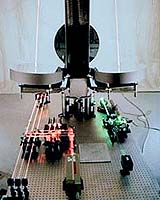
Kirtland Air Force Base NM (SPX) Jan 25, 2006 Positioning three delicate, circular mirrors to one one-thousandth of the width of a human hair consistently challenged scientists at the Space Vehicles Directorate, Kirtland Air Force Base, N.M. For five years they have studied the deployable optical telescope, a 1.5 meter (approximately 4.9 feet) in size demonstrator, which represents the future of foldable, larger aperture optics housed in existing launch vehicles. One year ago, the research team, however, discovered a breakthrough for the complex experiment and the technology advancement will eventually produce significantly improved tactical imagery supporting the joint warfighter on the battlefield. "When all of us in the beginning saw what we had to do to get the deployable optical telescope study completed, there were some doubts to getting it done because it might take too long, but we nailed it," said Dr. Lawrence "Robbie" Robertson, chief, Dynamics and Controls Group, Space Vehicles Directorate, Air Force Research Laboratory. "We wanted to give the warfighter better tactical imagery." In 1995, six researchers at the Space Vehicles Directorate desired to construct a larger telescope for the Air Force for applications in the cosmos, and within a few months, they had completed a conceptual design structure, conducted the required analysis, and began building a test bed for their vision. Serving as the experiment's model, NASA's Hubble Telescope, launched in April 1990 from the Space Shuttle Discovery, measured 2.4 meters (8 feet) in diameter and resembled a large school bus. For cost effectiveness, project personnel began investigating housing a similar-sized optical device in a standard launch vehicle by reducing the apparatus's dimensions through structural folding. During the test program's first five years a limited demonstrator exhibited some of the intended technologies, but did not have true optical mirrors, a crucial element. The follow-up experiment, the deployable optical telescope, comprised a scale representation of the concepts developed by the six scientists five years earlier, and involved a collaboration between public and private industries. For example, Kodak constructed the three 60-centimeter mirrors, Shafer Corp. built the three-meter deployable secondary tower, Boeing-SVS, Inc., and CSA Engineering, Inc., integrated the demonstrator's components, as well as assembled its control systems, and the Space Vehicles Directorate provided the primary main structure. NASA also served as a key program partner. "It really was an interdisciplinary team, and the project required one," Robertson said. "Early on, we teamed with NASA because we realized that the deployable optical telescope project was not going to require just Air Force Research Laboratory, but help from other federal government agencies to make it happen." Because of the sensitivity of its three optical mirrors, the deployable optical telescope resided in possibly the quietest confines in the country. To prevent minimal motion and vibration, the laboratory's floor consisted of bedrock with 50 feet of concrete poured on top. It took scientists at the Space Vehicles Directorate, Kirtland Air Force Base, N.M., years to develop the deployable optical telescope designed to fit into a typical rocket body. U.S. Air Force courtesy photo During the telescope's inaugural tests, the program added another control system to compensate for other vibrations produced by a construction crew working several feet away from the 1.5 meter structure. Nevertheless, another major challenge, arranging the mirrors to the miniscule dimension of one one-thousandth thickness of a human hair for sharper resolution, tested the researchers' resilience and patience. After four years of trial and error in folding and unfolding the three objects to the required placement specification, the program team finally reached the target benchmark. Team members employed four optical sensors and 18 pointing devices, as well as a laser-based sensing system, which measured the position at about 10,000 times per second. For the remaining nine months of the $40 million deployable optical telescope project, scientists continued to assess the correct location of the mirrors to ensure proper functioning in the space environment. The deployable optical telescope technology has been transitioned out to large aerospace companies to develop to build systems for the Air Force, NASA, and other potential customers. "Academia was also involved with the deployable optical telescope. We brought in professors from around the country to help with the pointing algorithms, and the result was a lot of new ideas and technologies for accurate positioning of structures/optics were spawned," Robertson said. For the deployable optical telescope project team, the phrase "patience is bitter, but its fruit is sweet," aptly describes the dedication, determination, and commitment displayed during the past 10 years. Mission accomplished. Related Links
 Carl Zeiss And Max Planck Researchers Develop Optical Technology For JWST
 Heidelberg, Germany (SPX) Dec 09, 2005
Carl Zeiss Optronics, in Oberkochen, Germany, and the Max Planck Institute for Astronomy in Heidelberg (MPIA), are developing the main fine mechanical optical technology for two instruments to be part of the James Webb Space Telescope (JWST).
--------------------------------------------------------- It's new. And it's downright terrific! Celestron's CPC Schmidt-Cassegrain telescope is the scope you've been waiting for! It offers new alignment technology, advanced engineering, and bold new design at a new, low price! In fact, Celestron's Professional Computerized (CPC) scope with revolutionary SkyAlign Alignment Technology redefines everything that amateur astronomers are looking for. It offers quick and simple alignment, GPS technology, unsurpassed optical quality, ease of use, advanced ergonomics, enhanced computerization and, most important, affordability. Want to view M-31 tonight? One button takes you there!
Shop for telescopes online at Telescopes.com! today!
|
|
|

| The content herein, unless otherwise known to be public domain, are Copyright 1995-2006 - SpaceDaily.AFP and UPI Wire Stories are copyright Agence France-Presse and United Press International. ESA PortalReports are copyright European Space Agency. All NASA sourced material is public domain. Additionalcopyrights may apply in whole or part to other bona fide parties. Advertising does not imply endorsement,agreement or approval of any opinions, statements or information provided by SpaceDaily on any Web page published or hosted by SpaceDaily. Privacy Statement |