|
 |
 |
 |
 |
 |
 |
 |
 |
 |

| . |  |
. |
Super Computer To Assist Space Program
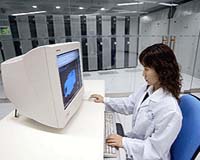
Beijing, China (SPX) Oct 27, 2005 Beijing's most powerful computer will play a role in China's space program as it will be used to conduct simulations on the country's first docking module, a key piece in future plans to build a space station. Computer engineers said Dawning4000A will also be used to improve the city's weather forecasting, particularly for the World Expo 2010. "Our computer can shrink the calculation period for testing airplanes from months to hours," said Li Genguo, a manager at the Shanghai Supercomputer Center. He said simulated space docking will be far more complicated and demanding than airplane tests. "We must operate very assured simulation tests on our computer before the actual spacecraft docking is conducted," Li said. He didn't say when space researchers will begin simulations on a docking module, but the work isn't expected to begin until at least 2007. Dawning4000A, which went into operation last year, is the fastest super computer in China and is capable of completing 11 trillion calculations per second. Engineers said simulated space docking involves so many variables that it would take a normal desktop computer months to complete a single task. According to the Shanghai Bureau of Astronautics, China will launch its third manned spacecraft, Shenzhou VII, in 2007 � a mission that is expected to involve China's first spacewalk. After that mission, researchers will begin to focus on the creation of a space station. Related Links SpaceDaily Search SpaceDaily Subscribe To SpaceDaily Express
 Creating A Better Transmission System For Deep-Space Applications
 San Jose CA (SPX) Oct 25, 2005
Recent advances in wireless computing technology could improve deep-space missions like asteroid research and remote spacecraft operations by changing the way signals are sent from Earth. |
|
|

| The content herein, unless otherwise known to be public domain, are Copyright 1995-2006 - SpaceDaily.AFP and UPI Wire Stories are copyright Agence France-Presse and United Press International. ESA PortalReports are copyright European Space Agency. All NASA sourced material is public domain. Additionalcopyrights may apply in whole or part to other bona fide parties. Advertising does not imply endorsement,agreement or approval of any opinions, statements or information provided by SpaceDaily on any Web page published or hosted by SpaceDaily. Privacy Statement |