|
 |
 |
 |
 |
 |
 |
 |
 |
 |

| . |  |
. |
Stardust Safely Home
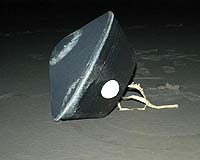
Moffett Field CA (SPX) Jan 16, 2006 The Stardust sample return capsule gently landed in the U.S. Air Force Utah Test and Training Range this morning at 3:10 a.m. Mountain time. Other than a little mud on its nose, the capsule appeared to be in excellent shape. A helicopter crew collected the capsule and brought it to a clean room at the nearby Michael Army Airfield. The capsule and its precious cargo are now being prepared for shipment to the Johnson Space Center in Houston, Texas. The capsule contains interstellar dust and samples of the comet Wild 2. The Stardust spacecraft passed within 150 miles of Wild 2's nucleus to collect particles streaming off the comet. There was some concern that the sample return capsule's parachutes would not work properly because they were similar in design to the parachutes for the Genesis mission. Genesis crashed into the Utah desert in 2004 when its parachutes failed to deploy. But Stardust encountered no problems; both its drogue and main parachute opened on schedule. "That's a culmination of over ten years worth of work," says Tom Duxbury, Stardust project manager from the Jet Propulsion Laboratory in Pasadena, California. "To see (the capsule) in one piece on the floor of the desert is just very moving." The Stardust spacecraft released its sample return capsule at 10:57 p.m. Mountain time Saturday night, and the capsule entered the Earth's atmosphere four hours later. Don Brownlee, Stardust principal investigator from the University of Washington in Seattle, sneaked outside to watch the capsule's entry into the atmosphere. He says it looked like an orange star that kept growing brighter and brighter, and had a visible tail. "It's ironic that you have a comet mission that ends producing a comet," says Brownlee. After the parachutes deployed, winds from a storm front carried the capsule away from the predicted landing spot, but it still landed well within the landing ellipsis. While the sample return capsule parachuted down to Earth, the Stardust spacecraft continued in its orbit around the sun. Although the spacecraft doesn't have another dust collector onboard, it has instruments that would allow it to study other comets -- a camera, a mass spectrometer to provide chemical analysis, and a dust counter to determine the particle size and spatial distribution of dust around a comet. In addition, the spacecraft still has 17 kilograms of propellant. "This spacecraft is a comet explorer," said Duxbury. "It has the tools to do a lot more." Although comet Wild 2 now moves between the orbits of Jupiter and Mars, it formed in the Kuiper Belt on the outskirts of the solar system. Scientists think the Kuiper Belt is a remnant of the solar system's original building blocks. The comet spent most of its lifetime in this cold outer region and therefore preserved most of its dust and gases. Brownlee says that by comparing the pristine comet dust with objects in the inner solar system - such as meteorites or even the planet Earth - and taking note of the differences, we can learn more about what processes occurred in the history of the solar system. "Over the coming weeks, months and years, I hope you'll be hearing a lot about this," says Brownlee. "I fully expect that textbooks in the future will have a lot of new information about the formation of our solar system from these samples that landed here this morning in Utah." Related Links University of Washington in Seattle SpaceDaily Search SpaceDaily Subscribe To SpaceDaily Express
 NASA's Stardust Probe In 'Excellent' Condition After Return To Earth
 Washington DC (AFP) Jan 15, 2006
The US space probe "Stardust" was in superb condition after returning to Earth Sunday carrying precious dust from stars and comets, according to mission officials. |
|
|

| The content herein, unless otherwise known to be public domain, are Copyright 1995-2006 - SpaceDaily.AFP and UPI Wire Stories are copyright Agence France-Presse and United Press International. ESA PortalReports are copyright European Space Agency. All NASA sourced material is public domain. Additionalcopyrights may apply in whole or part to other bona fide parties. Advertising does not imply endorsement,agreement or approval of any opinions, statements or information provided by SpaceDaily on any Web page published or hosted by SpaceDaily. Privacy Statement |