|
 |
 |
 |
 |
 |
 |
 |
 |
 |

| . |  |
. |
Snapshots At The Atomic Border
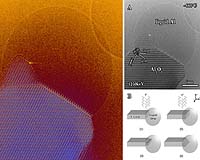
Stuttgart, Germany (SPX) Nov 29, 2005 In order to manufacture chips optimally, we need a comprehensive understanding of every process and phenomenon that takes place at the atomic level - in particular at the interface between solid and liquid materials. Scientists from the Max Planck Institute for Metals Research in Stuttgart and the Israel Institute of Technology in Haifa have now been able to observe atomic processes at the interface between liquid aluminium and solid aluminium oxide (sapphire). Using high voltage electron microscopy, they were able to show that crystals are able to order the atoms in neighbouring liquid metals, even at high temperatures. The results are important for procedures such as the wetting of joints in nanoscale "soldering" (Science, 28 October 2005) When non-specialists think of sapphire, they imagine a shimmering blue semi-precious stone - used, for example, as the needle on a record player. For scientists, however, the sapphire is also a particular form of aluminium oxide (a-Al203, also: corundum). A very stabile aluminium oxide, sapphire is used in many fields of technology. In semiconductor technology, for example, it insulates electronic components. In this and many other technological processes (e.g., solidification, crystal growing, and lubrication), the production process is being optimised and carried out at increasingly smaller dimensions. Therefore it is important to know what interactions take place at an atomic level, at the interface between solid and liquid materials. The interest in basic research into the structure and phenomena at solid-liquid interfaces has grown ever since x-ray diffraction studies, and atomic computer simulations, showed a high concentration of density fluctuations in the liquid phase at the interface. The Max Planck scientists investigated these processes more closely using a high-resolution transmission electron microscope, choosing liquid aluminium and the solid ceramic a-Al203 in crystallised form (Sapphire). They brought this material system under a high voltage electron microscope with a resolution of 0.12 nanometre at a temperature of 850 degrees Celsius, above the melting point of aluminium (660 degrees Celsius). The transmission electron microscope JEM-ARM 1250, JEOL, in Stuttgart, is one of the highest resolution machines of its kind in the world. The Max Planck scientists used this microscope to show, for the first time, that the density of atoms in liquid aluminium is not uniform right at the interface. There are, indeed, density fluctuations. By making small changes to the experimental conditions, the researchers were also able to observe both the growth of the sapphire from liquid aluminium, and the interfacial transport of oxygen atoms. The researchers captured the reaction on video at 25 frames per second, with cogent results unimpaired by artefact effects. The recordings showed how liquid aluminium atoms order themselves on the crystal interface. It also became possible to see that the interface develops dynamically and that the crystal grows in layers. The researchers infer from this that crystals can induce the ordering of atoms in liquids - even in metal-ceramic systems at high temperatures. The results could be useful for "soldering processes at the nanoscale", thus having future implications for the production of memory chips. Original work: S.H. Oh, C. Scheu, M. Ruhle, Y. Kauffmann und W.D. Kaplan Ordered Liquid Aluminium at the Interface with Sapphire Science, 28 October 2005. Related Links Max-Planck-Gesellschaft SpaceDaily Search SpaceDaily Subscribe To SpaceDaily Express
 Cardiff University Experts Drill Possibly World's Smallest Hole
 Cardiff, UK (SPX) Nov 29, 2005
Experts at Cardiff University have developed machinery so sophisticated that they can drill a hole narrower than a human hair. Such precision has potentially major benefits in medical and electronic engineering. |
|
|

| The content herein, unless otherwise known to be public domain, are Copyright 1995-2006 - SpaceDaily.AFP and UPI Wire Stories are copyright Agence France-Presse and United Press International. ESA PortalReports are copyright European Space Agency. All NASA sourced material is public domain. Additionalcopyrights may apply in whole or part to other bona fide parties. Advertising does not imply endorsement,agreement or approval of any opinions, statements or information provided by SpaceDaily on any Web page published or hosted by SpaceDaily. Privacy Statement |