| . |  |
. |
| . | |
. |


 by Staff Writers Pullman WA (SPX) Mar 06, 2018
Researchers from Washington State University and Tufts University have demonstrated for the first time that a single metal atom can act as a catalyst in converting carbon monoxide into carbon dioxide, a chemical reaction that is commonly used in catalytic converters to remove harmful gases from car exhaust. The research, published in the journal Nature Catalysis, could improve catalytic converter design and also has major implications in the field of computational catalysis.
Overcoming lower engine temperatures While studying low-temperature catalysts, the researchers, led by Jean-Sabin McEwen, assistant professor in WSU's Voiland School of Chemical Engineering and Bioengineering, and Charles Sykes, a professor of chemistry at Tufts University, got interested in single metal atoms and their ability to act as catalysts at lower temperatures. "Most of the harmful chemicals in your exhaust such as carbon monoxide and nitrogen oxide are emitted when starting up the engine," said McEwen. "The lower the temperature, the harder it is to neutralize these harmful chemicals."
Carbon monoxide to carbon dioxide "This is a benchmark study that can guide the design of the next generation of low temperature catalytic converters," said Sykes. Since catalytic converters use rare and expensive metals like platinum, reducing the use of those elements down to the single atom level could also reduce costs, he added. Their research also conclusively answers a longstanding debate in the scientific world on whether a single metal atom could act as a catalyst for the oxidation of carbon monoxide to carbon dioxide at low temperatures or whether such a reaction requires a cluster of atoms.
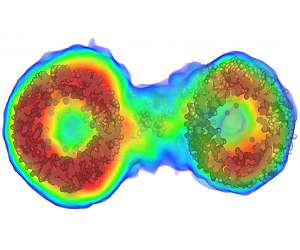
Powerful new imaging method reveals in detail how particles move in solution Buffalo NY (SPX) Mar 06, 2018 New research published in Nature Methods will dramatically improve how scientists "see inside" molecular structures in solution, allowing for much more precise ways to image data in various fields, from astronomy to drug discovery. The new method will allow for the visualization of many more biological molecules, providing critical information about what is inside molecules to scientists who currently can only access their outer shape or envelope. Such information could be a major boost to studies ... read more
|
|||||||||||||
| The content herein, unless otherwise known to be public domain, are Copyright 1995-2026 - SpaceDaily. All websites are published in Australia and are solely subject to Australian law and governed by Fair Use principals for news reporting and research purposes. By using our websites you consent to cookie based advertising. If you do not agree with this then you must stop using the websites from May 25, 2018. Privacy Statement. Additional information can be found here at About Us. |


 del.icio.us
 Digg
Digg Reddit
 Google






