|
 |
 |
 |
 |
 |
 |
 |
 |
 |

| . |  |
. |
People Excited For Successful Launching Of Shenzhou-6
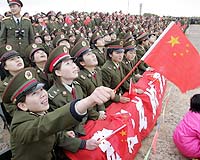
Beijing (SPX) Oct 13, 2005 Chinese people nationwide are in great excitement as learning about the successful launch of second manned spacecraft Shenzhou-6 on Wednesday morning. "I am very excited to see the successful liftoff of Shenzhou-6," said Tibetan woman Yuzhen, who delayed her routine pray every morning around Potala Palace for watching the live broadcasting onTV. "Shenzhou-6's successful launching indicates that our country is becoming more and more powerful, and with a powerful motherland,we common people would then live better lives," she said. In northwest China's Gansu Province, where the Jiuquan Satellite Launch Center is located, people were in special enjoyment for Shenzhou-6, since local people contribute a lot to China's space programme, including transferring villagers, improving transport system and providing such logistics guarantee as water and electricity supply. "Today's successful launch of Shenzhou-6 is the best return forour efforts," said Jiuquan Mayor Chen Chunming. "The astronauts' spirit is really encouraging for us to contribute more to China's space undertaking," he noted excitedly. A series of activities, such as singing and dancing performances, would be held in Jiuquan city in the next four to five days, to celebrate the success of Shenzhou-6's launch. After the multi-day space mission, the spacecraft will return to the main landing field in the central areas of Inner Mongolia Autonomous Region. Li Min, an official in charge of the craft's returning and landing at Siziwang banner, said local people were cheerful when seeing the process of Shenzhou-6's successful liftoff. "We would make utmost efforts to assure the safely landing of our spacecraft, to satisfy people all over the country," he said. No matter in China's remote areas or in prosperous cities such as Beijing, Shanghai, Guangzhou, the whole nation were in the gripof excitement. From residential buildings at Xuhui District of China's economic hub Shanghai, the sound of cheers and applause could be heard as the China Central Television (CCTV) showed the launching scene. In department stores of the city, customers were crowding in front of TV sets at the appliances sales counters to witness the historical moment "Shenzhou-6, as a forerunner of China's research on aerospace science, may arouse more people's fantasy on the space and universe," said Gu Xiaoming, a professor on history department of Fudan University. An Internet public-opinion poll among Shanghai citizens shows that 76 percent people were concerned about Shenzhou-6's liftoff process, 69 percent watched the live broadcasting on Shenzhou-6 from the CCTV. After the successful launch, 44 percent Shanghai respondents were mostly concerned about the techniques and safety measures of the spacecraft, 37 percent about the landing and 19 percent about the astronauts' lives in the space All respondents agreed that the successful launching of China's manned spacecraft Shenzhou-5 and Shenzhou-6 indicated the increasing of China's national power and that's really a pride of the Chinese people. Every Chinese again enjoy the excitement and pride of the successful launch of Shenzhou-6, two years after the successful spaceflight of Shenzhou-5. Millions of people witnessed the process of Shenzhou-6's liftoff through media. "Excitement", "proud", "expectation" became popular wordings when people left message in the Internet or accepted interview. "We are really proud to see our own spacecraft in the space," said a Beijing citizen Ms. Shi, who works in a foreign company. "But we still lag behind developed countries in aerospace technology, so we need to continue our efforts to peacefully apply the space resources, in a bid to benefit the mankind," she noted. Encouraged by Shenzhou-6's successful launch, teachers and students of Nanjing University of Aeronautics and Astronautics, and experts of a aerospace technology research institute in southwest China's Sichuan Province, expressed common willingness to increase their efforts to make new contribution to China's space programme
related report It is a very important step in telemetric control work, Dr. Liu Yingchun, a spacecraft orbit expert, said. The Shenzhou series from unpiloted 2 to 4 versions and manned Shenzhou-5 did the same in past voyages. The spaceship was 250 km above Earth when it entered the presetorbit. Moving at high speed, the spaceship was not running on a circular orbit, but elliptical with its altitude varying from 250 km at perigee to 350 km at apogee. "The orbit change is made for self-prompted emergency landing purposes," Liu said. After the change, the orbiting trajectory will be the same on the first, third and fifth days, which will be advantageous for the spacecraft returning to the priority landing site, according to Liu. It is also easier to make emergency returnplan for a spaceship on a circular orbit than on an elliptical one. "The earliest Shenzhou-1 ran on the elliptical orbit, but it orbited Earth only one day." It is relatively difficult to predicta proper landing as an elliptically running spaceship's altitude and speed are changing and its work data vary at every position, Liu said. To make the change, the ground command center sends the order to the spacecraft, adjusting work of engines onboard to tune its orbit close to a circular one, according to Liu.
related report The system, instead of being started when the craft returns and lands, begins operation when Shenzhou VI lifted off at 9:00 a.m. Wednesday, as the spaceship may run into emergency and have to return at any stage during its flight, said Hou Ying, chief designer of the landing field system. The system consists of five sub-systems, including main and auxiliary landing field sub-system, landing emergency rescue sub-system, off-shore emergency rescue sub-system, communication sub-system and astronaut medical care sub-system. Based on estimated failure possibilities of the spacecraft and geographical conditions of the seven provinces it flies over during ascending, four landing emergency rescue stations are set up in Jiuquan, Yinchuan, Yulin and Handan in northwest and north China and three off-shore rescue stations in the Yellow Sea, the East China Sea and the Pacific Ocean. "What the seven rescue stations do is to deal with emergencies during the 10-minute-odd ascending," Hou said, adding they have spent two years on preparation to ensure the safety of the astronauts. Most emergency rescue stations were closed after the spacecraft entered the preset orbit soundly.
related report According to Chinese television, Fei Junlung and Hei Hashen had a breakfast of fruits, cookies and water after they reached the orbit. The Chinese astronauts have convenient eating utensils, including special trays that fix cans and plastic packages with food. Individual preferences of the two pilots of Shenzhou-6 were also taken into account when their menu was being prepared. An official of the Chinese space programme said there are also Chinese original dishes in the menu - "yuxiang rousi" (pork with fish flavour) and "gungbao jiding" (slices of chicken with peanuts). Naturally, the Chinese space crewmembers can drink their favourite green tea without limit.
Source: Xinhua News Agency Related Links SpaceDaily Search SpaceDaily Subscribe To SpaceDaily Express
 Rocket Black Box Found In Inner Mongolia
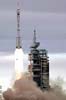 Otog, Inner Mongolia (XNA) Oct 13, 2005
The magnetic recorder, or "black box", that disengaged from the Long March II F rocket carrying the Shenzhou-6 spacecraft into orbit, has been found here 45 minutes after the blast-off Wednesday morning. |
|
|

| The content herein, unless otherwise known to be public domain, are Copyright 1995-2006 - SpaceDaily.AFP and UPI Wire Stories are copyright Agence France-Presse and United Press International. ESA PortalReports are copyright European Space Agency. All NASA sourced material is public domain. Additionalcopyrights may apply in whole or part to other bona fide parties. Advertising does not imply endorsement,agreement or approval of any opinions, statements or information provided by SpaceDaily on any Web page published or hosted by SpaceDaily. Privacy Statement |