|
 |
 |
 |
 |
 |
 |
 |
 |
 |

| . |  |
. |
Outside View: China's Space Message
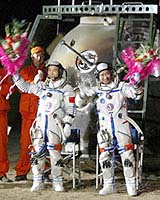
Moscow (UPI) Oct 17, 2005 With the successful launch of its second manned spacecraft, Shenzhou VI, China has shown the world that it is moving confidently towards the status of a global leader, one among eight or 10 -- or even two or three -- world powers that will be at the top in the next few years. China needed the second successful launch to vindicate its space program. Since 1996, it has launched a total of 46 unmanned craft, including five this year. All of them were put into orbit by the Chinese Long March rocket. The maiden mission by Col. Yang Liwei on Oct. 15, 2003, meant China joined the prestigious club of nations able to send a man into space, joining Russia and the United States. Also important is that Beijing stuck to its launching schedule for the second vehicle with two cosmonauts aboard. Beijing's space plans are an established reality now, even if they may occasionally suffer setbacks and delays, as is the case with other countries. These plans include a space walk in 2006, a family of new carrier rockets, including one capable of putting into orbit a research station weighing 20 tons, an unmanned craft to be sent around the Moon in 2007, a lunar landing in 2012, and the return to Earth of another lunar vehicle with soil samples in 2017. Like people, countries are sensitive to the way they are perceived by others. For a nation claiming world leadership, this is a particularly important issue, especially given that prestige in Chinese culture has a slightly more elevated status than in other cultures. The charm offensive launched by China was preplanned and, if not of primary significance, is still noteworthy in this undertaking. It is interesting to watch the reaction in other countries -- especially in the two other club members -- to the space duo turning to a space trio. American mass media never miss the chance to mention the military potential of any space program. And this is absolutely correct. High-precision weapons controlled via space will win future wars. Two out of three space powers, Russia and China, have long been lobbying the idea of keeping space as a demilitarized zone. So far, the problem has concerned weaponization of space. But control via space is something else. Perhaps China's space record will now push the world to new approaches to the problem, as China's nuclear history in the early 1960s drove the world to a non-proliferation treaty. But let us note also the way that China has served up its success both for home and international consumption. The operative word here is "scientific." This word, found in all speeches and reports from Beijing about the present launch, carries a multiple message -- especially in the light of what was said at a plenary meeting of the Chinese Communist Party central committee ahead of the launch. We have the world "scientific" there in all possible connotations. It applies above all to a new and balanced model of Chinese economic development. Until now, China has been advancing too fast, which has created problems. Now Beijing wants to balance out wealth and poverty in a more subtle fashion, between the regions and other areas, to give more thought to industrial impact on the environment, and so on. Space not only symbolizes "intelligent development" -- it works in quite tangible ways to promote the economy and a host of other fields, including ecology. And yet the inner symbolism of the space program is different. Perhaps few outside China remember the Cultural Revolution of the mid-1960s to the late 1970s. One of its effects was to leave several generations uneducated, which is a problem for the scientific and technical potential of the country today. The names of the first cosmonaut, Yang Liwei, as well as new space heroes Fei Junlung and Nie Haisheng, will be increasingly embodying in China not only courage, but also a desire to scale scientific and technological heights. This aspect of the matter concerns Russia directly. Those familiar with Russian-Chinese cooperation know that each year China is demonstrating a growing interest in new technologies in most diverse areas (although it tries to keep its space program separate). World leaders today are those who lead in science. China, through its space launches and otherwise, wants to send a signal to its people -- and the world -- that it not just realizes this truth, but is confidently following this path. Cooperating with China in the scientific and technological fields means creating a new reality for the country, its neighbors and partners. (Dmitry Kosyrev is a political commentator for the RIA Novosti news agency. This article is reprinted by permission of RIA Novosti.) (United Press International's "Outside View" commentaries are written by outside contributors who specialize in a variety of important issues. The views expressed do not necessarily reflect those of United Press International. In the interests of creating an open forum, original submissions are invited.) Related Links SpaceDaily Search SpaceDaily Subscribe To SpaceDaily Express
 After Shenzhou VI, China Sets Sights On Manned Space Station
 Beijing (AFP) Oct 17, 2005
After its most successful foray into space yet, China is preparing for its next major objective -- a space station giving the world's oldest civilization a permanent presence in orbit. |
|
|

| The content herein, unless otherwise known to be public domain, are Copyright 1995-2006 - SpaceDaily.AFP and UPI Wire Stories are copyright Agence France-Presse and United Press International. ESA PortalReports are copyright European Space Agency. All NASA sourced material is public domain. Additionalcopyrights may apply in whole or part to other bona fide parties. Advertising does not imply endorsement,agreement or approval of any opinions, statements or information provided by SpaceDaily on any Web page published or hosted by SpaceDaily. Privacy Statement |