|
 |
 |
 |
 |
 |
 |
 |
 |
 |

| . |  |
. |
Ottawa's EMS Wins Key Component Design Contract For NASA's JWST Telescope
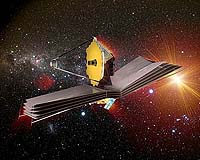
Longueuil QC (SPX) Sep 30, 2005 The Canadian Space Agency recently awarded a $26.2-million contract to the Space and Technology Group of Ottawa-based EMS Technologies for the detailed design of a fine guidance sensor and a tuneable filter for NASA's next-generation space telescope. The fine guidance sensor supplied by Canada is essential to the success of the mission. It will track the positions of very faint stars with great accuracy so that the James Webb Space Telescope (JWST) can be pointed steadily while its other instruments generate high-quality images. The level of precision achieved will be like aiming at a dime 100 km away. This critical role makes the Canadian team very proud to be part of this international project. The tuneable filter camera will provide unique scientific capabilities. One example of these is narrow-band imaging, a powerful way to explore the morphology of celestial objects at very specific wavelengths. Once launched in 2013, JWST will peer into the past, looking farther than has ever been possible. It will observe the formation of the first stars and galaxies of the universe and the beginning of time. With an aperture diameter of 6.5 m, the surface of the telescope's main mirror will be over seven times larger than Hubble's and hundreds of times more sensitive than any other telescope to near-infrared light. Its five-layer sunshield - almost as large as a tennis court - will keep the instruments at 37 degrees above absolute zero and will allow the telescope to detect faint, red-shifted signals from the early stages of the universe. JWST will be stationed 1.5 million km from Earth to ensure a stable and cold environment and reduce problems with stray light. As a partner in the project, Canada is guaranteed science time with the telescope. The Canadian science team in charge of the fine guidance sensor is led by Dr. John Hutchings of the National Research Council's Herzberg Institute of Astrophysics in Victoria, B.C. Dr. Rene Doyon of the physics department at the Universite de Montreal leads the science team in charge of the tuneable filter. Related Links SpaceDaily Search SpaceDaily Subscribe To SpaceDaily Express
 Through The Looking Glass - The Universe At Your Computer
 London, UK (SPX) Sep 30, 2005
Astronomers throughout the UK now have a valuable new research tool at their disposal which may lead to new discoveries and improved understanding of the physics of the Universe.
--------------------------------------------------------- It's new. And it's downright terrific! Celestron's CPC Schmidt-Cassegrain telescope is the scope you've been waiting for! It offers new alignment technology, advanced engineering, and bold new design at a new, low price! In fact, Celestron's Professional Computerized (CPC) scope with revolutionary SkyAlign Alignment Technology redefines everything that amateur astronomers are looking for. It offers quick and simple alignment, GPS technology, unsurpassed optical quality, ease of use, advanced ergonomics, enhanced computerization and, most important, affordability. Want to view M-31 tonight? One button takes you there!
Shop for telescopes online at Telescopes.com! today!
|
|
|

| The content herein, unless otherwise known to be public domain, are Copyright 1995-2006 - SpaceDaily.AFP and UPI Wire Stories are copyright Agence France-Presse and United Press International. ESA PortalReports are copyright European Space Agency. All NASA sourced material is public domain. Additionalcopyrights may apply in whole or part to other bona fide parties. Advertising does not imply endorsement,agreement or approval of any opinions, statements or information provided by SpaceDaily on any Web page published or hosted by SpaceDaily. Privacy Statement |