| . |  |
. |
| . | |
. |


 by Staff Writers Canberra, Australia (SPX) Dec 13, 2018
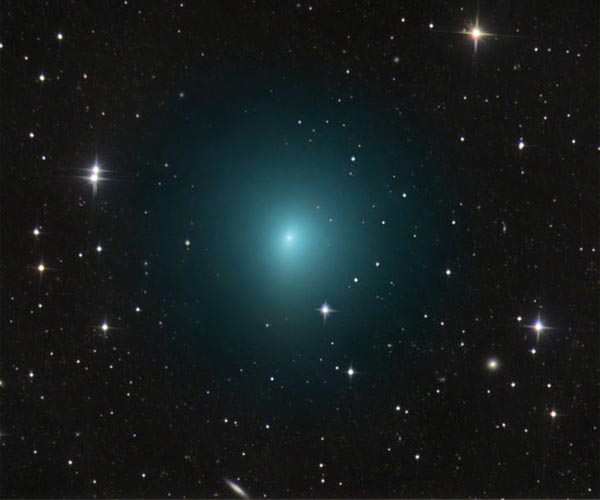
Amateur astronomers will be treated to two great spectacles this Friday night: a green, fuzzy comet - which appears only once every five years - and shooting stars, known as the Geminid meteor shower. ANU astronomer Dr. Brad Tucker said people should enjoy watching Comet 46P/Wirtanen, also known as the Christmas comet, while they can because they won't see this comet again for another few years. "Look towards the east with a small pair of binoculars or a telescope to see the green, fuzzy comet. It will be near the constellation Orion, or the saucepan [*]," said Dr. Tucker from the ANU Research School of Astronomy and Astrophysics. "This comet orbits the Sun roughly once every five years." At the same time, the Geminid meteor shower will light up the night sky as Earth passes through the tail of an asteroid. Small rocks break away from the asteroid, known as 3200 Phaethon, and burn up in the atmosphere to produce this spectacular event. The name Geminid comes from the Gemini constellation. The 3200 Phaethon asteroid does one orbit in 1.4 Earth years, and as it passes around the Sun bits of the asteroid come off. Dr. Tucker said the best time to see the comet would be from 9 pm this Friday (AEDT), and the shooting stars will light up the night-sky a few hours later from about 11:30 pm. "The meteor shower will be visible from anywhere in Australia and if you have a clear, dark view to the north and east, this will offer the best viewing - you can expect to see between 10 and 30 meteors per hour," he said. "Even in a city, you will be able to see the brighter meteors."

New insights on comet tails are blowing in the solar wind Greenbelt MD (SPX) Nov 05, 2018 Engineers and scientists gathered around a screen in an operations room at the Naval Research Laboratory in Washington, D.C., eager to lay their eyes on the first data from NASA's STEREO spacecraft. It was January 2007, and the twin STEREO satellites - short for Solar and Terrestrial Relations Observatory - which had launched just months before, were opening their instruments' eyes for the first time. First up: STEREO-B. The screen blinked, but instead of the vast starfield they expected, a pearly ... read more
|
|||||||||||||
| The content herein, unless otherwise known to be public domain, are Copyright 1995-2026 - SpaceDaily. All websites are published in Australia and are solely subject to Australian law and governed by Fair Use principals for news reporting and research purposes. By using our websites you consent to cookie based advertising. If you do not agree with this then you must stop using the websites from May 25, 2018. Privacy Statement. Additional information can be found here at About Us. |

 del.icio.us
 Digg
Digg Reddit
 Google







