| . |  |
. |
| . | |
. |


 by Staff Writers Riga (AFP) Feb 4, 2016
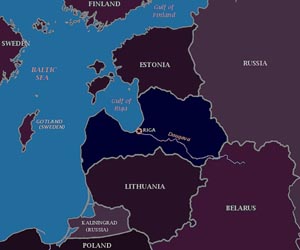
A BBC television drama depicting a Russian-backed rebellion in Latvia has triggered an outcry in the small Baltic NATO and EU state, with the foreign minister slamming the plot as "rubbish". The programme, titled "Third World War: Inside The War Room", aired on Wednesday and featured scenes of a Kremlin-supported rebellion in Latvia's eastern Latgale region, clearly modelled on the conflict in eastern Ukraine. "Watched BBC2 World War 3: Inside the War Room, while scenario of separatists in Latgale is rubbish, overall many lessons to learn for all," Foreign Minister Edgars Rinkevics said on Twitter. The show used former senior military, diplomatic and security service staff to make decisions on a British response to Russian aggression, also showed them not retaliating in the face of a Russian nuclear attack on London. It could be watched by viewers in Latvia with satellite TV, and local news programmes showed some of the more dramatic sequences. Under NATO's Article 5 provision for collective defence, an attack against one ally is an attack against all and automatically triggers a security response. Under Moscow's thumb in Soviet times, Latvia and fellow Baltic states Estonia and Lithuania have been on edge since Russia annexed the Crimean peninsula from Ukraine in 2014. The Baltic trio and nearby Poland, which will host a NATO summit in July, have called on the Western defence alliance to reinforce its presence in the region because of their concern over Russia. A Rand Corporation threat assessment published on Wednesday found that it would take just 60 hours for Russia to take over Estonia and Latvia. "Across multiple games using a wide range of expert participants in and out of uniform playing both sides, the longest it has taken Russian forces to reach the outskirts of the Estonian and/or Latvian capitals of Tallinn and Riga, respectively, is 60 hours," Rand said in its report. "Such a rapid defeat would leave NATO with a limited number of options, all bad." Rand suggests that "a force of about seven brigades" including heavy armour supported by air power, "on the ground and ready to fight at the onset of hostilities could suffice to prevent the rapid overrun of the Baltic states."
Related Links Learn about the Superpowers of the 21st Century at SpaceWar.com Learn about nuclear weapons doctrine and defense at SpaceWar.com
|
|||||||||||||
| The content herein, unless otherwise known to be public domain, are Copyright 1995-2026 - SpaceDaily. All websites are published in Australia and are solely subject to Australian law and governed by Fair Use principals for news reporting and research purposes. By using our websites you consent to cookie based advertising. If you do not agree with this then you must stop using the websites from May 25, 2018. Privacy Statement. Additional information can be found here at About Us. |


 del.icio.us
 Digg
Digg Reddit
 Google