|
 |
 |
 |
 |
 |
 |
 |
 |
 |

| . |  |
. |
Keeping Space Free Of Debris
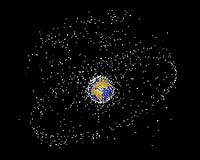
Paris - Nov 27, 2003 On 22 February 1986, a European Ariane 1 launcher orbited SPOT 1, the first European Earth observation satellite decided by the governments of Belgium, Sweden and France. Initially designed to operate for three years, SPOT 1 has since supplied commercial operator Spot Image with more than 2.7 million high-quality satellite images. Now at the end of its service lifetime, SPOT 1 is being de-orbited by engineering teams at CNES' Toulouse Space Centre starting since 17 November, lowering the satellite into an orbit below 600 kilometres. Although still capable of acquiring high-quality imagery after 18 years in service, SPOT 1 has reached the end of its operating lifetime. Consequently, CNES has decided to use the satellite's last reserves of fuel to place it in a lower orbit. If the satellite was left alone at its current altitude, it would continue to orbit the planet for another 200 years before re-entering the atmosphere, gradually breaking up over the years and leaving a trail of debris in its wake. Guidelines laid down in October 2002 by the Inter Agency Space Debris Coordination Committee (IADC) are designed to avert such situations by requiring all satellites in low-Earth orbit to be de-orbited within no more than 25 years. Although the guidelines do not in fact apply to SPOT 1, which was built well before they came into effect, CNES has decided to set an example by voluntarily de-orbiting the satellite. In this lower orbit, SPOT 1 will be subjected to higher drag that will cause it gradually to lose altitude and break up naturally in the atmosphere after about 15 years, thus posing no danger to populations on Earth. The other three SPOT satellites-SPOT 2, SPOT 4 and SPOT 5-will continue to deliver imagery, which is marketed by Spot Image. SPOT 5's enhanced performance has confirmed the remarkable imaging capability of the SPOT Earth observation system in service since 1986. The recent contract awarded to EADS Astrium to build two Pleiades satellites carrying high-resolution instruments supplied by Alcatel Space assures continuity of service for the next decade. Related Links Centre National d'Etudes Spatiales SpaceDaily Search SpaceDaily Subscribe To SpaceDaily Express
 ESA Awards The First Aurora Mission Design Contracts
  Paris (ESA) Oct 01, 2003
A major milestone in ESA's long-term Aurora programme of Solar System exploration has been passed with the announcement of the winners of competitive contracts for two of the programme's key robotic missions - ExoMars and Earth re-entry Vehicle Demonstrator (EVD). |
|
|

| The content herein, unless otherwise known to be public domain, are Copyright 1995-2006 - SpaceDaily.AFP and UPI Wire Stories are copyright Agence France-Presse and United Press International. ESA PortalReports are copyright European Space Agency. All NASA sourced material is public domain. Additionalcopyrights may apply in whole or part to other bona fide parties. Advertising does not imply endorsement,agreement or approval of any opinions, statements or information provided by SpaceDaily on any Web page published or hosted by SpaceDaily. Privacy Statement |