|
 |
 |
 |
 |
 |
 |
 |
 |
 |

| . |  |
. |
Is There Another World In The Mirror, Case Physicist Asks
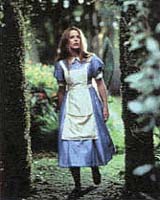
Cleveland OH (SPX) Oct 26, 2005 Like Lewis Carroll's Alice, who steps through the looking glass into a strange world, Lawrence Krauss, Case Western Reserve University professor of physics, began his search for extra dimensional worlds with the Twilight Zone episode, "Little Lost Girl." Krauss explores the fascination both scientists and lay people have with the possibility that there that is more out there than meets the eye�in his new book, Hiding in the Mirror: the Mysterious Allure of Extra Dimensions, from Plato to String Theory and Beyond (Viking Press). Forty years after watching the television show that involved a little girl falling through a portal to another dimension (which Krauss says terrified him as a child), he immediately thought of that episode when he decided to write the book. But Krauss also wonders whether the episode subconsciously influence his life today, as the neighborhood hero who rescued the child was a physicist. Krauss only remembered this piece of information when he was doing research for his seventh popular science book and watched the episode again. Krauss indicated that man's speculations about other dimensions has a long history, going back to at least Plato's allegory of people trapped in a cave who must watch the changing shadows on the wall in order to interpret the real events taking place in the world beyond their direct view. This speculation has carried on through science fiction, art and literature in the 20th century, and has culminated in the recent scientific fascination with the idea that the universe may contain as many as 10 or 11 dimensions of space, arising from string theory. "One thing that has connected man through the ages is his imagination...it is the world beyond our experience where we are digging deep into our own psyches," Krauss writes. Like Krauss' other books, Hiding in the Mirror has its own science lessons. Krauss said this book afforded him the opportunity to present a historical review of empirical science in the last two centuries, beginning with the discovery of the laws of electromagnetism that eventually would lead to larger questions about the link between time and space that Albert Einstein would solve in 1915 with his general relativity theory. The book continues through the remarkable discoveries associated with the nature of the subatomic world, including the discoveries of nearly exotic particles such as positrons, muons, neutrinos, and quarks that have led mankind to a new understanding of the four forces in nature, and to a clear appreciation that somehow gravity is fundamentally different than the other forces in a way that is still not understood. It is the attempt to reconcile gravity and quantum mechanics that led scientists in the 1980s to explore string theory, with its possibility of extra dimensions. "I wanted to update the reader on current research and give them a balanced treatment of the string theory to let them see for themselves whether they believe in extra dimensions," said Krauss. Krauss is the Ambrose Swasey Professor of Physics and Astronomy at Case and his own work involves exploring the fundamental forces in the cosmos by attempting to understand the large scale evolution of the Universe. The book is already being billed as the first "fair and balanced" treatment of string theory, as Krauss attempts to separate the popular hoopla from the realities. It has already gotten considerable advance attention through news stories describing the current debate over string theory, and praise from such well known figures as Walter Isaacson, author of the bestselling Benjamin Franklin: An American Life, and former CEO and head of CNN, who calls it a "brilliant, thrilling book." Hiding in the Mirror has become a main selection of the Scientific American Book Club. Krauss concludes the book with a discussion of something even more exotic than the possibility of six or seven extra microscopically small extra dimensions. This involves the recent theoretical discovery that some or all of these dimensions could in fact be infinitely large and still remain hidden, a discovery that was made in part by one of Krauss' former doctoral students. Krauss acknowledges, however, that "Today, there is no more evidence that extra dimensions exist than there was 100 years ago." Recent discoveries continued to spark the human imagination about the unknown world, says Krauss, but "Science does not operate in a vacuum. These ideas about extra dimension keep cropping up century after century, and it might be telling us something�if not about the natural world, then at least about the human mind." Related Links Case Western Reserve University SpaceDaily Search SpaceDaily Subscribe To SpaceDaily Express
 Ultrafast Lasers Take 'Snapshots' As Atoms Collide
 Boulder CO (SPX) Oct 24, 2005
Using laser pulses that last just 70 femtoseconds (quadrillionths of a second), physicists have observed in greater detail than ever before what happens when atoms collide. |
|
|

| The content herein, unless otherwise known to be public domain, are Copyright 1995-2006 - SpaceDaily.AFP and UPI Wire Stories are copyright Agence France-Presse and United Press International. ESA PortalReports are copyright European Space Agency. All NASA sourced material is public domain. Additionalcopyrights may apply in whole or part to other bona fide parties. Advertising does not imply endorsement,agreement or approval of any opinions, statements or information provided by SpaceDaily on any Web page published or hosted by SpaceDaily. Privacy Statement |