|
 |
 |
 |
 |
 |
 |
 |
 |
 |

| . |  |
. |
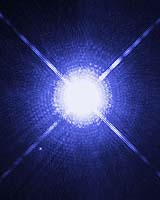
Hubble And Einstein "Weigh" Nearest White Dwarf Star
Baltimore MD (SPX) Dec 14, 2005 Astronomers have used NASA's Hubble Space Telescope to get the most precise measurement ever made of a tiny shift in the light from Earth's nearest white dwarf star and, using Einstein's theory of general relativity, accurately determined the incredibly dense star's mass. The white dwarf star, Sirius B, is a companion to Sirius A, the brightest star in the night sky. The binary star system is only 8.6 light years from Earth. (A light year is the distance light travels in one year, roughly six trillion miles.) But ground-based astronomers have found it impossible to precisely measure light from Sirius B because it is swamped by the glare of the ten-thousand times brighter Sirius A. Jay B. Holberg and Ivan Hubeny of The University of Arizona are members of the team led by Martin Barstow of the University of Leicester, U.K., who used the Hubble to get sharp views of just the white dwarf star, unpolluted by light from Sirius A. White dwarf stars are the dying remnant cores of stars similar to the sun. Our sun will eventually become a white dwarf. Applying Einstein's general relativity theory, the team determined that Sirius B packs 98 percent of the mass of our sun within its 7,500-mile diameter (12,000 kilometers), or within a volume slightly smaller than Earth. Albert Einstein proposed the general relativity theory in 1915. It says that the gravity of any mass, such as a planet or star, has the effect of warping the space and time around it. Einstein predicted that astronomers would observe light losing a fraction of its energy because of a massive star's intense gravitational field. They would see light shifted to longer, redder wavelengths. The phenomenon is called "gravitational redshift" effect. Sirius B has an intense gravitational field that warps space and slows time far more dramatically than we experience on Earth. If we humans were to stand on Sirius B, we'd be crushed by space warped by gravity. A 150-pound person would weigh 50 million pounds. (But on the upside, if we Earthlings could survive, we wouldn't age as quickly.) "The nature of the ashes of these dead stars give us important clues about the lives and deaths of stars like our own sun," Barstow said. "The nuclear waste of carbon and oxygen produced in the process are essential elements for life and are eventually recycled into interstellar space to form new stars, planets and, possibly, living beings." "Sirius' strange companion (Sirius B) has played a key role in the development of physics and astrophysics since 1915, when it first alerted astronomers to the existence of enormously dense states of matter," Holberg added. Astronomers first measured the gravitational redshift in light from Sirius B in 1925, helping confirm Einstein's general relativity theory. As a young graduate student at Cambridge University in the early 1930s, Subramanyan Chandrasekhar used Einstein's theory of special relativity and quantum mechanics to show how white dwarf stars could exist. He also deduced that no white dwarf could ever have more mass than 1.4 solar masses. Chandrasekhar's work was dismissed until the 1960s, then recognized with the Nobel Prize in physics in 1983. Related Links The University of Arizona University of Leicester NASA's Hubble Space Telescope SpaceDaily Search SpaceDaily Subscribe To SpaceDaily Express
 Physicists Store And Retrieve Single Photons Between Remote Memories
 Atlanta GA (SPX) Dec 12, 2005
A series of publications in the journal Nature highlights the race among competing research groups toward the long-anticipated goal of quantum networking.
--------------------------------------------------------- It's new. And it's downright terrific! Celestron's CPC Schmidt-Cassegrain telescope is the scope you've been waiting for! It offers new alignment technology, advanced engineering, and bold new design at a new, low price! In fact, Celestron's Professional Computerized (CPC) scope with revolutionary SkyAlign Alignment Technology redefines everything that amateur astronomers are looking for. It offers quick and simple alignment, GPS technology, unsurpassed optical quality, ease of use, advanced ergonomics, enhanced computerization and, most important, affordability. Want to view M-31 tonight? One button takes you there!
Shop for telescopes online at Telescopes.com! today!
|
|
|

| The content herein, unless otherwise known to be public domain, are Copyright 1995-2006 - SpaceDaily.AFP and UPI Wire Stories are copyright Agence France-Presse and United Press International. ESA PortalReports are copyright European Space Agency. All NASA sourced material is public domain. Additionalcopyrights may apply in whole or part to other bona fide parties. Advertising does not imply endorsement,agreement or approval of any opinions, statements or information provided by SpaceDaily on any Web page published or hosted by SpaceDaily. Privacy Statement |