|
 |
 |
 |
 |
 |
 |
 |
 |
 |

| . |  |
. |
Frequent Starbursts Sterilize Center Of Milky Way
Boston MA (SPX) Oct 05, 2004 Life near the center of our galaxy never had a chance. Every 20 million years on average, gas pours into the galactic center and slams together, creating millions of new stars. The more massive stars soon go supernova, exploding violently and blasting the surrounding space with enough energy to sterilize it completely. This scenario is detailed by astronomer Antony Stark (Harvard-Smithsonian Center for Astrophysics) and colleagues in the October 10, 2004, issue of The Astrophysical Journal Letters. The team's discovery was made possible using the unique capabilities of the Antarctic Submillimeter Telescope and Remote Observatory (AST/RO). It is the only observatory in the world able to make large-scale maps of the sky at submillimeter wavelengths. The gas for each starburst comes from a ring of material located about 500 light-years from the center of our galaxy. Gas collects there under the influence of the galactic bar-a stretched oval of stars 6,000 light-years long rotating in the middle of the Milky Way. Tidal forces and interactions with this bar cause the ring of gas to build up to higher and higher densities until it reaches a critical density or "tipping point." At that point, the gas collapses down into the galactic center and smashes together, fueling a huge burst of star formation. "A starburst is star formation gone wild," says Stark. Astronomers see starbursts in many galaxies, most often colliding galaxies where lots of gas crashes together. But starbursts can happen in isolated galaxies too, including our own galaxy, the Milky Way. The next starburst in the Milky Way is coming relatively soon, predicts Stark. "It likely will happen within the next 10 million years." That assessment is based on the team's measurements showing that the gas density in the ring is nearing the critical density. Once that threshold is crossed, the ring will collapse and a starburst will blaze forth on an unimaginably huge scale. Some 30 million solar masses of matter will flood inward, overwhelming the 3 million solar mass black hole at the galactic center. The black hole, massive as it is, will be unable to consume most of the gas. "It would be like trying to fill a dog dish with a firehose," says Stark. Instead, most of the gas will form millions of new stars. The more massive stars will burn their fuel quickly, exhausting it in only a few million years. Then, they will explode as supernovae and irradiate the surrounding space. With so many stars packed so close together as a result of the starburst, the entire galactic center will be impacted dramatically enough to kill any life on an Earth-like planet. Fortunately, the Earth itself lies about 25,000 light-years away, far enough that we are not in danger. The facility used to make this discovery, AST/RO, is a 1.7-meter-diameter telescope that operates in one of the most challenging environments on the planet-the frigid desert of Antarctica. It is located at the National Science Foundation's Amundsen-Scott Station at the South Pole. The air at the South Pole is very dry and cold, so radiation that would be absorbed by water vapor at other sites can reach the ground and be detected. "These observations have helped advance our understanding of star formation in the Milky Way," says Stark. "We hope to continue those advancements by collaborating with researchers who are working on the Spitzer Space Telescope's Legacy Science Program. AST/RO's complementary observations would uniquely contribute to that effort." Stark's co-authors on the paper announcing this finding are Christopher L. Martin, Wilfred M. Walsh, Kecheng Xiao and Adair P. Lane (Harvard-Smithsonian Center for Astrophysics), and Christopher K. Walker (Steward Observatory). Related Links SpaceDaily Search SpaceDaily Subscribe To SpaceDaily Express
 Genesis Team Hopeful About Samples
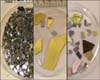 Dugway UT (SPX) Sep 17, 2004
Genesis team scientists and engineers continue their work on the mission's sample return canister in a specially constructed clean room at the U.S. Army Proving Ground in Dugway, Utah. As more of the capsule's contents are revealed, the team's level of enthusiasm for the amount of science obtainable continues to rise. |
|
|

| The content herein, unless otherwise known to be public domain, are Copyright 1995-2006 - SpaceDaily.AFP and UPI Wire Stories are copyright Agence France-Presse and United Press International. ESA PortalReports are copyright European Space Agency. All NASA sourced material is public domain. Additionalcopyrights may apply in whole or part to other bona fide parties. Advertising does not imply endorsement,agreement or approval of any opinions, statements or information provided by SpaceDaily on any Web page published or hosted by SpaceDaily. Privacy Statement |