|
 |
 |
 |
 |
 |
 |
 |
 |
 |

| . |  |
. |
France Launches Australian Military Satellite Half Owned By Singapore Govt
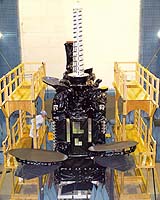
Palo Alto - June 11, 2003 The Optus and Defence C1 communications satellite, built by Space Systems/Loral (SS/L) under contract from Mitsubishi Electric Corporation for Optus of Australia, was successfully launched today at 6:38pm EDT 22:38 GMT, sent into space from the Spaceport at Kourou, French Guiana aboard an Ariane 5 rocket. Optus and Defence C1 is one of the most advanced communications satellites ever built, carrying a total of 16 antennas that will provide 18 beams across Australia, New Zealand, and the Asia-Pacific region, as well as global beams covering a large area from India to Hawaii. The advanced communications payload operates in four different frequency bands -- commercial services at Ku-band, and military communications at UHF, X- and Ka-bands. It will operate from an orbital slot at 156 degrees East longitude. "The successful launch of Optus and Defence C1 is the culmination of a unique commercial and military partnership," said Patrick DeWitt, president of SS/L. "Optus and Defence C1 will serve as an important example of the benefits that commercial satellites can provide in certain types of military communications - including reduced costs and shorter deployment times. We are proud to have been chosen to participate in this pioneering effort." Optus, a leading Australian integrated telecommunications company, will use Optus and Defence C1's Ku-band payload to distribute video, direct-to-home TV, and telephony and Internet connections to remote areas. For the Australian Department of Defence, the satellite's Ka-band payload will provide high-data-rate broadcast coverage for video, and voice and data communications. The X-band payload will provide medium- to high-data-rate voice and data for land and maritime applications. The UHF payload will provide secure low-rate voice and data communications to mobile platforms. The Optus and Defence C1 satellite is based on SS/L's space-proven 1300 geostationary satellite platform, which has an excellent record of reliable operation. The 1300 is designed to achieve a long life, in this case 15 years. The 1300 achieves high stability by using bipropellant propulsion and momentum-bias attitude control systems. A system of high-efficiency solar arrays and batteries provide uninterrupted electrical power. Total satellite power will be approximately 10 kW at end of life (EOL), and the spacecraft will have a launch mass of nearly five metric tons. In total, SS/L satellites have amassed more than 1,000 years of on-orbit service. Optus managed the procurement, teamed with the Australian Department of Defence. Japan's Mitsubishi Electric Corporation (MELCO), the prime contractor, teamed with SS/L, which designed, assembled, integrated and tested the spacecraft at its California facility. SS/L also supplied the Ku-band subsystem. MELCO was responsible for the overall payload. Optus is Australia's leading integrated communications company, serving around six million customers each day. The company provides a broad range of communications services including mobile, national and long distance services, local telephony, business network services, Internet and satellite services and subscription television. Related Links SpaceDaily Search SpaceDaily Subscribe To SpaceDaily Express
 Lockheed Martin's LOSAT Successfully Fires Guided Missile
 Dallas - June 11, 2003
The Line-of-Sight Antitank (LOSAT) System, developed by Lockheed Martin, successfully completed Engineering Development Flight Test-1 (EDF-1) at White Sands Missile Range, N.M., yesterday. |
|
|

| The content herein, unless otherwise known to be public domain, are Copyright 1995-2006 - SpaceDaily.AFP and UPI Wire Stories are copyright Agence France-Presse and United Press International. ESA PortalReports are copyright European Space Agency. All NASA sourced material is public domain. Additionalcopyrights may apply in whole or part to other bona fide parties. Advertising does not imply endorsement,agreement or approval of any opinions, statements or information provided by SpaceDaily on any Web page published or hosted by SpaceDaily. Privacy Statement |