|
 |
 |
 |
 |
 |
 |
 |
 |
 |

| . |  |
. |
Einstein's Relativity Theory Proven With The 'lead' Of A Pencil
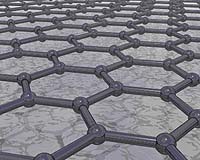
Manchester, UK (SPX) Nov 10, 2005 Scientists at The University of Manchester have discovered a new way to test Einstein's theory of relativity using the 'lead' of a pencil. Until now it was only possible to test the theory by building expensive machinery or by studying stars in distant galaxies, but a team of British, Russian and Dutch scientists has now proven it can be done in the lab using an ultra-thin material called Graphene. The group, led by Professor Andre Geim of the School of Physics and Astronomy, discovered the one atom thick material last year. Graphene is created by extracting one atom thick slivers of graphite via a process similar to that of tracing with a pencil. Professor Geim, said: "To understand implications of the relativity theory, researchers often have to go considerable lengths, but our work shows that it is possible to set up direct experiments to test relativistic ideas. In theory, this will speed up possible discoveries and probably save billions of pounds now that tests can be set up using Graphene and relatively inexpensive laboratory equipment." In a paper published in Nature (November 10, 2005), the team describes how electric charges in Graphene appear to behave like relativistic particles with no mass (zero rest mass). The new particles are called massless Dirac fermions and are described by Einstein's relativity theory (so-called the Dirac equation). The team also reports several new relativistic effects. They have shown that massless Dirac fermions are pulled by magnetic fields in such a manner that they gain a dynamic (motion) mass described by the famous Einstein's equation E=mc2. This is similar to the case of photons (particles of light) that also have no mass but can still feel the gravitational pull of the Sun due their dynamic mass described by the same equation. Dr Kostya Novoselov, a key investigator in this research, added: "The integer and fractional quantum Hall effects are two of the most remarkable discoveries of the late 20th century. It is not easy to explain their significance but both discoveries led to Nobel prizes. One can probably appreciate the importance of our present work in terms of fundamental physics, if I mention that one of the phenomena we report is a new, relativistic type of the quantum Hall effect." Related Links University of Manchester SpaceDaily Search SpaceDaily Subscribe To SpaceDaily Express
 What Does 'Almost Nothing' Weigh? FSU Physicist Aims To Find Out
 Tallahassee FL (SPX) Nov 09, 2005
If subatomic particles had personalities, neutrinos would be the ultimate wallflowers. One of the most basic particles of matter in the universe, they've been around for 14 billion years and permeate every inch of space, but they're so inconceivably tiny that they've been called "almost nothing" and pass straight through things - for example, the Earth - without a bump. |
|
|

| The content herein, unless otherwise known to be public domain, are Copyright 1995-2006 - SpaceDaily.AFP and UPI Wire Stories are copyright Agence France-Presse and United Press International. ESA PortalReports are copyright European Space Agency. All NASA sourced material is public domain. Additionalcopyrights may apply in whole or part to other bona fide parties. Advertising does not imply endorsement,agreement or approval of any opinions, statements or information provided by SpaceDaily on any Web page published or hosted by SpaceDaily. Privacy Statement |