|
 |
 |
 |
 |
 |
 |
 |
 |
 |

| . |  |
. |
Cloned Cells May Be More Youthful
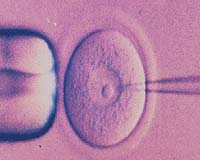
Washington (UPI) Jun 29, 2005 A Massachusetts biotech company said Wednesday that research it has conducted in cows indicates cloning techniques produce vivacious cells that have a competitive advantage over adult stem cells and may offer greater therapeutic potential. "This paper documents for the first time an important new paradigm - that cloned cells are not only immune compatible, but that they are more youthful, and potentially of far greater therapeutic value," said leading author Dr. Robert Lanza, vice president of medical and scientific development at Advanced Cell Technology in Worcester, Mass. "People tend to think of cloning as a way to create genetically matched cells," Lanza told United Press International, "but an important aspect of this technology that gets overlooked is that it might be able to take decrepit cells and restore them back to a youthful state." The findings, which appear in the June issue of the journal Cloning and Stem Cells, could lead to treatments for autoimmune diseases, multiple sclerosis, arthritis, diabetes and other conditions, Lanza said. "Further evidence of the therapeutic potential of cells derived from cloned embryos is provided in this exciting paper," said Ian Wilmut, editor in chief of Cloning and Stem Cells. Wilmut, who also is head of the Department of Gene Expression and Development at the Roslin Institute in Edinburgh, Scotland, gained prominence in 1996 when his research team produced Dolly the sheep, the first animal cloned from an adult cell. Korean researchers recently showed therapeutic cloning was possible in people. The cloned cells, however, were not transplanted back into the person, so though it is likely they would have survived long term in the body, that is not known for certain. Advanced Cell's study suggests the cells not only would have survived, but also would have flourished. The scientific consensus is therapeutic cloning and embryonic-stem-cell research has the potential to lead to therapies and insights about disease, but it remains controversial because it requires the destruction of human embryos. Four years ago President George W. Bush limited federal funding for stem-cell research to several lines of cells derived prior to Aug. 9, 2001. Recent months have seen increasing opposition among members of Congress to the limited funding. The House passed legislation last month that would allow federal funding of studies involving embryonic stem cells derived from surplus embryos at fertilization clinics that are destined to be discarded. Similar legislation, known as the Stem Cell Research Enhancement Act, is pending in the Senate. A bipartisan group of senators, including Gordon Smith, R-Ore., and Edward Kennedy, D-Mass., held a news conference Wednesday to urge passage of the bill. Bush has said he would veto such legislation. In the study, Lanza and researchers from the Memorial Sloan-Kettering Cancer Center, the Mayo Clinic and the University of Pennsylvania used older cows equivalent to an 80-year-old person. Cows were used because their immune systems function more closely to human immune systems than other research animals, Lanza said. The researchers used cloning techniques to produce cow fetuses from cells from the animals. Lanza said if researchers applied the technique to humans, it would instead produce cloned embryos, from which embryonic stem cells could be derived. Adult stem cells - known as hematopoietic stem cells - were extracted from the livers of the cloned fetuses and transplanted back into the original donor cows. Hematopoietic stem cells give rise to blood cells and immune-system cells. The researchers found evidence the cloned cells survived in the older cows and multiplied in the blood, bone marrow and lymph nodes for more than a year. "We gave the animals less than a tablespoon of cloned stem cells, and half a year later up to 60 percent of the progenitor cells in the blood of the animals" originated from the transplanted cells, Lanza said. In addition, the team found 10 times more cells than would be expected from a transplant of normal adult stem cells, he said. Lanza said his company is thinking of applying the technology to AIDS. By cloning cells from a patient and then knocking out the receptors used by the AIDS virus to gain entry into those cells, they then could be transplanted back into the patient, increasing resistance to the disease, he said. Related Links SpaceDaily Search SpaceDaily Subscribe To SpaceDaily Express
 Library On A Slide Microarray Puts 30,000 Genomes On A Single Slide
 Ann Arbor - Mar 23, 2004
A novel application of microarray technology, where up to 30,000 whole genomes are printed on a single slide, is described in the journal BMC Microbiology this week. |
|
|

| The content herein, unless otherwise known to be public domain, are Copyright 1995-2006 - SpaceDaily.AFP and UPI Wire Stories are copyright Agence France-Presse and United Press International. ESA PortalReports are copyright European Space Agency. All NASA sourced material is public domain. Additionalcopyrights may apply in whole or part to other bona fide parties. Advertising does not imply endorsement,agreement or approval of any opinions, statements or information provided by SpaceDaily on any Web page published or hosted by SpaceDaily. Privacy Statement |