|
 |
 |
 |
 |
 |
 |
 |
 |
 |

| . |  |
. |
Chinese Start Real Space Lives: Experts
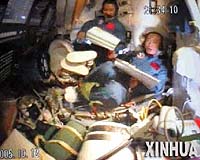
Beijing (XNA) Oct 13, 2005 With Chinese astronaut Fei Junlong aboard the Shenzhou-6 spacecraft entering the orbital capsule from the re-entry capsule, the Chinese people began space lives in its real sense, experts said Wednesday. Nie Haisheng, another Shenzhou-6 astronaut, in exchange, moved to the orbital module later. The move across capsules in spacecraft, the first of its kind undertaken by Chinese astronauts in space since the launch of the manned Shenzhou-5 in 2003, enables the crew, on China's second manned space mission, to shake off heavy space suit and conduct experiments and scientific research in work clothes. "Orbital capsule is the place for astronauts to live and work during their space flight," said Wang Yongzhi, chief general designer of China's Manned Spaceflight Program, noting that the astronauts aboard the Shenzhou-6 will conduct a series of experiments during their multi-day mission. "This is a significant breakthrough of China's space technology since the successful spaceflight of manned spacecraft Shenzhou-5," Wang said. During this first multi-manned and multi-day spaceflight of Shenzhou-6, astronauts' normal life and activities, such as eating, drinking, sleeping and excreting, must be assured, said Yang Liwei, China's first astronaut and now deputy commander-in-chief of the astronaut system of Shenzhou-6 Manned Space Program. Yang said the two astronauts aboard the Shenzhou-6 were accessible for such foods at the orbital capsule as rice, vegetable and meat, which can be heated up, for such beverage as coffee, orange juice and green tea, and also for some spices. Sleeping bag and the excrement collecting facility are also provided in the orbital capsule. "This living system needs to be tested by this spaceflight," Yang said. Compared with Shenzhou-5, China's first manned spacecraft orbiting the Earth two years ago, more than 110 technical modifications have been made for the 9.2-meter-long Shenzhou-6. "This is the first time for Shenzhou spacecraft to apply the whole system, and the successful flight this time would indicate that China's technology in Shenzhou spacecraft is close to be mature," said Zhang Bainan, chief designer of the spacecraft system. China's second manned space mission with the Shenzhou-6 spacecraft will be the country's first human-controlled space scientific experiment program, said Hu Wenrui, academician of the Chinese Academy of Sciences (CAS) and of the International Academy of Astronautics (IAA). Human participation will help realize a significant step forward in space scientific experiments, Hu said, noting that the exploration of celestial bodies can be undertaken efficiently by machines based on automation approaches, albeit there still exist missions that machines unable to accomplish at present. "Without human participation, however, space scientific experiments will only involve a few tested items and have limited effect," Hu said. Gu Yidong, chief designer of the spacecraft application system of China's manned space program, said the two astronauts aboard the Shenzhou-6 are requested to initially verify the feasibility of experiment control and to cultivate capability of operation in space. In the nation's future manned space missions, scientists will likely be sent for space experiment, Gu added. Source: Xinhua News Agency Related Links SpaceDaily Search SpaceDaily Subscribe To SpaceDaily Express
 Rocket Black Box Found In Inner Mongolia
 Otog, Inner Mongolia (XNA) Oct 13, 2005
The magnetic recorder, or "black box", that disengaged from the Long March II F rocket carrying the Shenzhou-6 spacecraft into orbit, has been found here 45 minutes after the blast-off Wednesday morning. |
|
|

| The content herein, unless otherwise known to be public domain, are Copyright 1995-2006 - SpaceDaily.AFP and UPI Wire Stories are copyright Agence France-Presse and United Press International. ESA PortalReports are copyright European Space Agency. All NASA sourced material is public domain. Additionalcopyrights may apply in whole or part to other bona fide parties. Advertising does not imply endorsement,agreement or approval of any opinions, statements or information provided by SpaceDaily on any Web page published or hosted by SpaceDaily. Privacy Statement |