|
 |
 |
 |
 |
 |
 |
 |
 |
 |

| . |  |
. |
China Updating Missile Arsenal
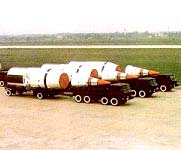
UPI Senior News Analyst Washington DC (UPI) July 11, 2007 China now has an arsenal of at least 400 nuclear weapons and an arsenal of 20 intercontinental ballistic missiles and other delivery systems to carry them, a report said this week. "At this time, reports have placed the number of deployable nuclear weapons China possesses at 400. Of these, around 20 are deployed in the intercontinental ballistic missile configuration," GlobalResearch.ca reported Monday. GR's estimate of the number of Chinese ICBMs currently deployed was lower than some other estimates that have been published. But the report also warned that Beijing had many more nukes that could be delivered in other ways. "Nearly 220 are reported to be deployed in various delivery platforms such as aircrafts, submarines and short-to-medium range missile systems," it said. "All of these weapons are of tactical capability," the report said. "The remaining weapons are held in tactical reserves for short range missiles, low yield attacks and demolition purposes." GR said the main ICBM in China's strategic arsenal remains the Dong-Feng 5, which is a liquid-fueled missile, greatly slowing its preparation for launch time. The missile has a range of 7,800 miles, the report said. The report noted that the venerable Dong-Feng 5 "was first deployed in the summer of 1981 and has remained the backbone of China's ICBM force for the past two decades." It said the Chinese military kept 20 of them on full alert in the center of the country. The missiles are not capable of carrying multi-independently targeted vehicle, or MIRV-ed warheads. But the article also noted that China is now moving into the capability of deploying new missiles on mobile launchers that do not have to launch from fixed ground silos as the old Dong Feng-5 do, and that will also have solid-fuel propellants allowing them to be launched far more quickly. GR said the medium range DF 31 "entered first-line operation in 2005." A more ambitious ICBM version of the design, the DF 41, "is expected to be fielded by late 2010," the report said.
Source: United Press International Community Email This Article Comment On This Article Related Links GlobalResearch.ca Learn about nuclear weapons doctrine and defense at SpaceWar.com Learn about missile defense at SpaceWar.com All about missiles at SpaceWar.com Learn about the Superpowers of the 21st Century at SpaceWar.com
 Bulava ICBM Breakthrough
 Moscow (RIA Novosti) July 11, 2007
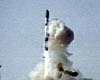
Russian Space Agency head Anatoly Perminov recently congratulated Yury Solomonov, general designer of the Moscow Heat Technology Institute, on the successful submarine launch of a new sea-based strategic missile, the Bulava, which was developed by his institute. The launch was part of a series of flight tests. Such publicity given to an event so ordinary and routine may seem strange, but only at first glance. |
|
|

| The content herein, unless otherwise known to be public domain, are Copyright 1995-2007 - SpaceDaily.AFP and UPI Wire Stories are copyright Agence France-Presse and United Press International. ESA Portal Reports are copyright European Space Agency. All NASA sourced material is public domain. Additional copyrights may apply in whole or part to other bona fide parties. Advertising does not imply endorsement,agreement or approval of any opinions, statements or information provided by SpaceDaily on any Web page published or hosted by SpaceDaily. Privacy Statement |