| . |  |
. |
| . | |
. |


 by Staff Writers Boston MA (SPX) Sep 08, 2016
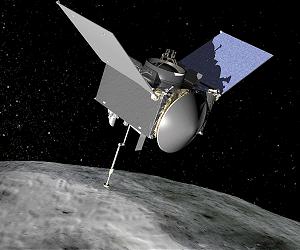
At 7:05pm (EDT), Thursday, Sept. 8, NASA plans to launch a spacecraft to a near-Earth asteroid named Bennu. Among that spacecraft's five instruments is a student experiment that will use X-rays to help determine Bennu's surface composition. The Regolith X-Ray Imaging Spectrometer, or REXIS, was developed by researchers and students at the Harvard-Smithsonian Center for Astrophysics (CfA) and the Massachusetts Institute of Technology (MIT), both in Cambridge, Mass. It is only the second student experiment to fly on a NASA interplanetary mission. "With Harvard undergraduates, we designed a wide-field X-ray imaging instrument that was built by students at MIT," says Harvard astronomer and Deputy Instrument Scientist Josh Grindlay. Richard Binzel at MIT is Instrument Scientist for REXIS. "A principal goal for REXIS was educating students," says instrument scientist and Harvard astronomer Jaesub Hong. The mission, called the Origins, Spectral Interpretation, Resource Identification, Security- Regolith Explorer (OSIRIS-REx), will be launched with an Atlas V from Cape Canaveral, Florida. After its two-year journey to Bennu, the spacecraft will spend nearly two years making observations and measurements before collecting a surface sample and returning it to Earth. REXIS will help the mission team select the sample site by characterizing the asteroid"s surface. Bennu emits X-rays through a process known as fluorescence, in which X-rays from the Sun make atoms on the asteroid"s surface glow at specific energies, depending on which chemical elements are present. "REXIS can image enhanced patches of glowing elements like magnesium, silicon, or iron that are typical in chondrite-type asteroids," says instrument scientist Branden Allen. The asteroid Bennu is about 1,600 feet across, about twice the height of Boston's John Hancock Tower. REXIS will be able to resolve details about 18 feet across. Like many asteroids, Bennu represents a relic from the solar system's formation. It formed as bits of primitive material stuck together over time. As a result, it can tell scientists about the history of our solar system. Asteroids like Bennu may have delivered water, carbon, and other substances crucial to life to the early Earth. REXIS is a $5 million project that involved nearly 50 undergraduate students from MIT and Harvard.
Related Links Harvard-Smithsonian Center For Astrophysics Asteroid and Comet Mission News, Science and Technology
|
|||||||||||||
| The content herein, unless otherwise known to be public domain, are Copyright 1995-2026 - SpaceDaily. All websites are published in Australia and are solely subject to Australian law and governed by Fair Use principals for news reporting and research purposes. By using our websites you consent to cookie based advertising. If you do not agree with this then you must stop using the websites from May 25, 2018. Privacy Statement. Additional information can be found here at About Us. |


 del.icio.us
 Digg
Digg Reddit
 Google