|
 |
 |
 |
 |
 |
 |
 |
 |
 |

| . |  |
. |
Nano World: Energy From Nanotech Chips
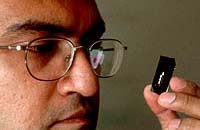
New York (UPI) Sep 02, 2005 Power generators based on nanotechnology that can fit on a microchip could help drive military and medical devices or cell phones and laptops in the future, experts told UPI's Nano World. "This technology is considerably less expensive than existing chemical and physical processes," said researcher Shubhra Gangopadhyay, a physicist at the University of Missouri at Columbia. "The possibilities are endless in terms of what this energy can do." The researchers are coated devices made of glass with a mixture of nanoparticle fuel such as aluminum and oxidizer such as iron oxide. The nanoparticle quality of the fuel and oxidizer provides far greater surface area for explosive reactions than a conventional mixture would. When ignited, the nanoparticle combination releases a tremendous amount of thermal and mechanical energy. "Temperatures can reach more than 2,000 degrees Celsius in a very localized area," Gangopadhyay said. Thermoelectric and piezoelectric components can then convert the heat and shock waves to electricity, respectively. The researchers are currently working to couple thermoelectric and piezoelectric materials to produce energy on a single chip. The invention does not require electricity to start it. All that is needed is friction or impact. "When you look into generating electric energy, you want to make sure the output is more than the input, and you don't need to initiate this with electrical energy," Gangopadhyay said. Their device could generate pulses of energy in only fractions of a second, of potential use in defense applications such as initiating explosives. This power could also be stored for later use in portable electronics, much like batteries. The shock waves might also find use in medical devices, to destroy kidney stones perhaps, Gangopadhyay explained. "We need to perform a thorough study to reduce the energy needed to initiate the chemical reaction. We also need to design a chip to sustain energy generation for a longer time period and store it properly for later use," she added. "It's very exciting work," Partha Dutta, a physicist at Rensselaer Polytechnic Institute in Troy, N.Y., told UPI's Nano World. "The defense applications look to be the right way to go, as there is a lot of money there, and will need a lot of money to get this going that you won't get from venture capital. The work they carry out over the next two or three years will be very critical - they will need to do a lot of trials and try to incorporate these devices into many types of systems to get applications going." The researchers are developing their invention via their company NEMS & MEMS Works in Columbia, Mo., and currently are seeking a patent for their device. "This research is at a nascent and fledgling stage," Gangopadhyay cautioned. "It needs a significant amount of work to bring this technology to market." She expected commercializing their advance should take at least five years. All rights reserved. � 2005 United Press International. Sections of the information displayed on this page (dispatches, photographs, logos) are protected by intellectual property rights owned by United Press International.. As a consequence, you may not copy, reproduce, modify, transmit, publish, display or in any way commercially exploit any of the content of this section without the prior written consent of United Press International. Related Links University of Missouri at Columbia SpaceDaily Search SpaceDaily Subscribe To SpaceDaily Express  Nano World: Nano Pens Can 'Write' Circuits
 New York (UPI) Aug 30, 2005
Fountain pens that write on the nanometer scale could help create advanced microchips or medical and genetic devices, experts told UPI's Nano World.
|
|
| |||||||||
| The content herein, unless otherwise known to be public domain, are Copyright 1995-2016 - Space Media Network. All websites are published in Australia and are solely subject to Australian law and governed by Fair Use principals for news reporting and research purposes. AFP, UPI and IANS news wire stories are copyright Agence France-Presse, United Press International and Indo-Asia News Service. ESA news reports are copyright European Space Agency. All NASA sourced material is public domain. Additional copyrights may apply in whole or part to other bona fide parties. Advertising does not imply endorsement, agreement or approval of any opinions, statements or information provided by Space Media Network on any Web page published or hosted by Space Media Network. Privacy Statement All images and articles appearing on Space Media Network have been edited or digitally altered in some way. Any requests to remove copyright material will be acted upon in a timely and appropriate manner. Any attempt to extort money from Space Media Network will be ignored and reported to Australian Law Enforcement Agencies as a potential case of financial fraud involving the use of a telephonic carriage device or postal service. |