|
 |
 |
 |
 |
 |
 |
 |
 |
 |

| . |  |
. |
A DRY MARS? - Part 1 - 2 - 3 - 4 - 5 - 6 - 7 - 8 - 9 - 10 - 11 - 12 - 13 - 14
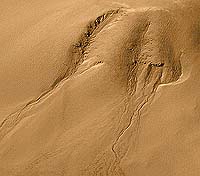
by Peter Ravenscroft Samford - August 16, 2000 - One of the keys to understanding the valleys and channels of Mars is the ubiquitous dunes, in particular the barchan dune trains to be seen running along the beds of so many of them. They are not compatible with water flow, and they are clearly active now. If the effects of their movement in any particular channel over billions of years is considered, the existence of the channel can be fully explained without liquid water flow. They represent persistent flows of highly abrasive material. The mechanism presently shifting them, namely airflow, is perfectly adequate to account for the observed erosion and transport, over the very long time period available. In this view, the very old drainage networks with well-developed tributaries represent the action of aeolian erosion and transport in terrain where resistive bedrock has been exposed for very long periods. The abrasive sand flow there, over aeons, would pick the lines of weakness between the rocks and gradually develop a network of flow channels, exactly as water does on Earth. The particular drainage pattern developed would depend on the rock type eroded, as here. Single-channel canyons do not form in such hard terrain on Earth, unless they are controlled by tectonics and are immature. Fortes (1998) noted: "Valley networks superficially resemble terrestrial dendritic networks but have;
If the erosion that forms these networks is driven by wind, the narrower junction angles would follow. Flow lines would not develop at high angles to the dominant wind direction. The sequence of channel formation outlined above accounts for the undissected surfaces � they have not yet been affected by the erosion cycle. Where they start and end is a function of local wind directions, sun angles, impacts and permafrost volumes, none of which need to match the controls that affect water flow. Hence the puzzle. The topographic gradient, which totally controls water flow, will be important, but not an absolutely rigid determinant. Moreover, sediments borne by wind can move readily uphill, as cliff-top dunes on this planet show so often. The massive outflow channels in contrast to the valley networks are nearly devoid of tributaries. I suggest this is because they have been cut mainly through porous and softer material, mostly thick aeolian deposits built up since the early volcanism that created the hard-rock terrains ceased. On Earth, well-developed drainage networks develop where the fluid responsible - almost always liquid water - flows over and transports material across much of the surface being eroded. Deep incised canyons with few tributaries are features that tend to develop in terrain where, with the exception of along the bed of the canyon itself, major surface flow of sediment does not occur.
|
|
| |||||||||
| The content herein, unless otherwise known to be public domain, are Copyright 1995-2016 - Space Media Network. All websites are published in Australia and are solely subject to Australian law and governed by Fair Use principals for news reporting and research purposes. AFP, UPI and IANS news wire stories are copyright Agence France-Presse, United Press International and Indo-Asia News Service. ESA news reports are copyright European Space Agency. All NASA sourced material is public domain. Additional copyrights may apply in whole or part to other bona fide parties. Advertising does not imply endorsement, agreement or approval of any opinions, statements or information provided by Space Media Network on any Web page published or hosted by Space Media Network. Privacy Statement All images and articles appearing on Space Media Network have been edited or digitally altered in some way. Any requests to remove copyright material will be acted upon in a timely and appropriate manner. Any attempt to extort money from Space Media Network will be ignored and reported to Australian Law Enforcement Agencies as a potential case of financial fraud involving the use of a telephonic carriage device or postal service. |