|
 |
 |
 |
 |
 |
 |
 |
 |
 |

| . |  |
. |
A WORLD OF LEAKS - PART ONE - PART TWO - PART THREE
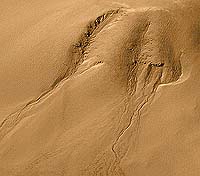
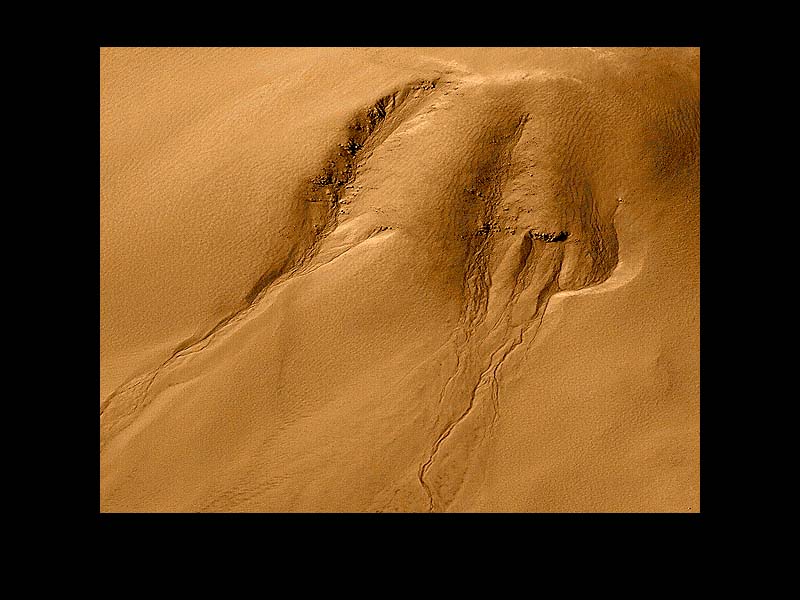
by Bruce Moomaw Cameron Park - June 27, 2000 - The potential impact of a highly variable axial tilt was addressed extensivelly in a SpaceDaily feature concerning extrasolar planets last year. If Earth was keeled over on its side, wiht one pole at a pointing continuously at the Sun for months at a time, that area would become roasting hot -- while Earth's equator would be sufficiently cooled over the year that Earth would have an "equatorial belt" of ice rather than polar icecaps. Indeed, if a planet is keeled over on its side, the average temperature of its poles over the whole year is considerably higher than that of its equator, despite the fact that each pole also faces AWAY from the Sun for months at a time during each orbit. And when Mars' axial tilt is currently on the "increase" part of its cycle of change, its poles become significantly warmer than they were just a few tens of thousands of years ago -- and its equator becomes colder. Thus, as the polar regions become even a few degrees warmer, the subsurface gas pressure of trapped near-surface CO2 in the polar regions will significantly increase -- and if the temperature becomes warm enough for briny water to thaw out all the way to the surface in these regions, some fresh eruptions will occur in these areas. Meantime, as Mars' equatorial regions become colder, the soil there will absorb more CO2 from Mars' atmosphere, which will then gradually be buried deeper underground by Mars' continuously blowing dust storms. (So Mars' large underground store of carbon dioxide very slowly but continuously "migrates" back and forth from its polar regions to its equator as its axial tilt increases and decreases.) Why are we seeing evidence of eruptions in the south polar regions, but not in the north? Perhaps because of the major differences in the intensity of the seasons in Mars' northern and southern hemispheres. Mars (unlike every other planet save Pluto and Mercury) has a significantly lopsided orbit, and during the current era its southern hemisphere is pointed toward the Sun during its perihelion (closest approach to the Sun) and away during its aphelion (farthest point from the Sun) -- so that southern summers are warmer, and southern winters colder, than those in the north. In their LPSC abstract, Kuzmin and Zabalueva say that their calculations indicate that this would make it much easier for their hypothesized briny water to liquify all the way to the surface right now during southern summers than northern ones -- and the difference would be even greater if Mars' axial tilt were greater than it is now. This explanation may be complicated by the fact that Mars' spin axis also "precesses" (wobbles around like that of a top) over a a slow cycle of 51,000 years (as opposed to Earth's precession cycle of 26,000 years). Thus it's possible that earlier in the current obliquity cycle, Mars' northern hemisphere may actually have had warmer summers than the southern hemisphere -- in which case seltzer eruptions may have taken place earlier there than in the south, and their traces have since been covered up by wind-blown dust (which plays a large role in erasing Martian geological features). Wind-blown dust and sand may also explain why we see no traces of any eruptions that occurred in Mars' equatorial latitudes: they may have occurred still earlier in the obliquity cycle -- when Mars' axial tilt was decreasing and its equator was warming up while the poles were becoming colder -- and their traces would be even more thoroughly covered by now. (If Mars' axial tilt is currently on the "decrease" part of the cycle, so that the equator is once again warming up while the poles cool down, it may be about time for us to start seeing a new wave of fresh eruptions closer to the equator.) In short, Mars just may be a salty soda fountain controlled by its obliquity cycle! However, it's obviously quite possible that this theory is wrong. For one thing, Dr. Kenneth Tanaka -- who wrote a commentary on Malin and Edgtett's paper which appears in the same issue of "Science" -- is skeptical of Kuzmin and Zabalueva's belief that liquid brines can ever make it to Mars' surface; he tells me that Mars is so cold, even during its high-obliquity periods, that "even salty water should generally be frozen to depths of a couple of kilometers or so; therefore, it may be difficult to pump it up to the surface without it freezing, except near volcanoes or large impacts." But this is at least one possibility that explains the strange pattern of observed facts -- and even if the "obliquity" part of the theory is false, the overall idea that some kind of periodic subsurface warming (perhaps relatively mild geothermal heating) may be causing natural fountains of briny seltzer to erupt on Mars is a very plausible explanation for MGS' strange findings. However, several other alternative theories also exist -- and in the next parts of my report, I'll describe those.
PLANET SCIENCE
|
|
| |||||||||
| The content herein, unless otherwise known to be public domain, are Copyright 1995-2016 - Space Media Network. All websites are published in Australia and are solely subject to Australian law and governed by Fair Use principals for news reporting and research purposes. AFP, UPI and IANS news wire stories are copyright Agence France-Presse, United Press International and Indo-Asia News Service. ESA news reports are copyright European Space Agency. All NASA sourced material is public domain. Additional copyrights may apply in whole or part to other bona fide parties. Advertising does not imply endorsement, agreement or approval of any opinions, statements or information provided by Space Media Network on any Web page published or hosted by Space Media Network. Privacy Statement All images and articles appearing on Space Media Network have been edited or digitally altered in some way. Any requests to remove copyright material will be acted upon in a timely and appropriate manner. Any attempt to extort money from Space Media Network will be ignored and reported to Australian Law Enforcement Agencies as a potential case of financial fraud involving the use of a telephonic carriage device or postal service. |