|
 |
 |
 |
 |
 |
 |
 |
 |
 |

| . |  |
. |
ROBOTIC MARS - PART ONE - PART TWO - PART THREE - PART FOUR - PART FIVE
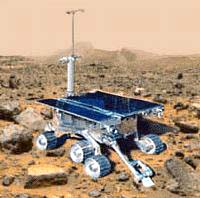
by Bruce Moomaw Cameron Park - June 5, 2000 - There is no doubt at all that this spacecraft could be prepared for a 2003 flight. But even if the Mobile Lander can't be made ready in time, there is some question in my mind as to whether the 2003 Orbiter would be worth the cost. Most of its instruments are near-duplicates of those on the European Space Agency's "Mars Express" orbiter, already firmly scheduled for 2003. Still, more coverage of greater areas on Mars' surface would be scientifically valuable in itself, and Mars Express doesn't really carry any good analog of the PMIRR instrument. (This makes me wonder whether NASA may perhaps end up going with a third and cheaper alternative: simply reflying the Mars Climate Orbiter in 2003, along with whatever additional instruments can be safely crammed onto it.) On NASA may end up simply flying nothing to Mars in 2003, and waiting till 2005 to resume its program. One inside source tells "SpaceDaily" that NASA has decided to delay the tiny Mars communications satellite -- weighing only 220 kg -- that it had planned to launch separately in 2003 as a piggyback "Micromission" on board a European Ariane 5 rocket. If so, this puzzles me. If the Mobile Lander is flown in 2003, this would leave it with only two possible Mars orbiting relay comsats -- the (old) 2001 Orbiter, and the Mars Express -- and if they both failed, it would have to fall back entirely on direct-to-Earth communications that would very greatly reduce its scientific return. I'm awaiting further word on this subject. Even if Mobile Lander does fly, I also wonder what will happen to the four additional instrument packages that had been scheduled for the 2001 Lander (along with a duplicate of the Sojourner rover and five of Athena's six instruments, mostly on the stationary lander itself). I think it very likely that one of them -- the tiny descent camera first carried on the Polar Lander, which would have photographed the surface from altitudes of 7 km down to only 7 meters -- will be added to the Mobile Lander. Scientists are agreed that aerial photos of the landscape around a landing site are extremely important in order to understand its geology -- and that they are absolutely indispensable to plan out in advance the scientifically best possible route for a rover to follow after landing. But the other three instrument packages are more doubtful.. Two of them, the "MARIE" radiation detector and the "MECA" package of chemical and microscopic soil analysis instruments, were part of NASA's "HEDS" (Human Exploration and Development of Space) program; they were designed to detect possible environmental hazards for later manned expeditions to Mars -- which, as NASA freely admits, are now even farther off than they were before. I think it possible that some of the smaller and lighter sensors in the MECA package might be added to Athena, such as a sensor on the rover's instrument arm to detect static electrical charge buildups from Martian dust that could be dangerous to electronic equipment on both manned and unmanned vehicles. But except for that, I think it's safe to say that these two experiments are now very much on the back burner.
|
|
| |||||||||
| The content herein, unless otherwise known to be public domain, are Copyright 1995-2016 - Space Media Network. All websites are published in Australia and are solely subject to Australian law and governed by Fair Use principals for news reporting and research purposes. AFP, UPI and IANS news wire stories are copyright Agence France-Presse, United Press International and Indo-Asia News Service. ESA news reports are copyright European Space Agency. All NASA sourced material is public domain. Additional copyrights may apply in whole or part to other bona fide parties. Advertising does not imply endorsement, agreement or approval of any opinions, statements or information provided by Space Media Network on any Web page published or hosted by Space Media Network. Privacy Statement All images and articles appearing on Space Media Network have been edited or digitally altered in some way. Any requests to remove copyright material will be acted upon in a timely and appropriate manner. Any attempt to extort money from Space Media Network will be ignored and reported to Australian Law Enforcement Agencies as a potential case of financial fraud involving the use of a telephonic carriage device or postal service. |