|
 |
 |
 |
 |
 |
 |
 |
 |
 |

| . |  |
. |
Digging For Life On Mars
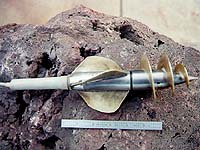
by Mark Schrope for New Scientist Find liquid water on Mars, and life may not be far behind. Many scientists believe that this water can only exist thousands of metres beneath the planet's surface. So a team of engineers at NASA's Jet Propulsion Laboratory in Pasadena, California, is developing a robotic mole that can drill deep into Mars and return samples to the surface through a tube that it constructs as it digs. JPL's Martian mole moves through the ground like a piledriver, repeatedly raising an internal weight and then hammering it into the ground. On Mars it will be wired up to a set of solar panels on the surface that provide only enough power to illuminate a few light bulbs. So the designers had to make a machine that could penetrate the ground using only this meagre power. The design JPL came up with has a hammer head that spins at up to 20,000 revolutions per minute before engaging a central thread that drives it into the ground. This delivers roughly twice the force of a sledgehammer blow on Earth, and enables the mole to burrow at up to 10 metres per day. As it digs, the mole extrudes a tiny tube containing two passageways which provide a link to the surface and back. Liquid xenon circulating through these tubes will carry samples that can be sieved and analysed on the surface. One possible target for the mission is a potential aquifer that many scientists believe may exist about 5 kilometres down near the Martian equator, says Brian Wilcox, the project leader. Another option is to aim for one of the planet's polar ice caps and study Mars's climate history over the past few million years by examining ice samples. The group has already built a prototype of the hammer mechanism and is now planning the tube extruder. In 2002, Wilcox plans to test the complete system in the Alaskan permafrost. He says his team could be ready to tackle Mars within a decade. "Drilling may well be the only way we can get to places that have a chance of having life on Mars today," says Michael Carr, a geologist at the US Geological Survey who is reviewing NASA's Mars programme. This article appeared in the September 16, 2000 issue of New Scientist. Copyright 2000 - All rights reserved. The material on this page is provided by New Scientist and may not be published, broadcast, rewritten or redistributed without written authorization from New Scientist. Related LinksHow To Drill On Mars From The Comfort Of Your Desktop May 1998 "Mars Hydrosphere Drilling Workshop" at Los Alamos: Beagle 2 webpage: Beagle 2 mole: Subsurface Explorer: Honeybee "Inchworm Mole": Onboard sample-analysis instruments for a mole: Honeybee Robotics 10-meter sampling core drill: Design of overall NASA program for drilling into Mars' subsurface: SpaceDaily Search SpaceDaily Subscribe To SpaceDaily Express  How To Drill On Mars From The Comfort Of Your Desktop
 Cameron Park - July 27, 2000 Cameron Park - July 27, 2000Even if we succeed - through orbital or aerial radar sounding - in locating some spots on Mars where liquid water may be within a few dozen or a few hundred meters of the surface, we're left with the next stage of the problem: how do we drill down that far to reach it with unmanned landers and associated rovers at reasonable cost?
|
|
| |||||||||
| The content herein, unless otherwise known to be public domain, are Copyright 1995-2016 - Space Media Network. All websites are published in Australia and are solely subject to Australian law and governed by Fair Use principals for news reporting and research purposes. AFP, UPI and IANS news wire stories are copyright Agence France-Presse, United Press International and Indo-Asia News Service. ESA news reports are copyright European Space Agency. All NASA sourced material is public domain. Additional copyrights may apply in whole or part to other bona fide parties. Advertising does not imply endorsement, agreement or approval of any opinions, statements or information provided by Space Media Network on any Web page published or hosted by Space Media Network. Privacy Statement All images and articles appearing on Space Media Network have been edited or digitally altered in some way. Any requests to remove copyright material will be acted upon in a timely and appropriate manner. Any attempt to extort money from Space Media Network will be ignored and reported to Australian Law Enforcement Agencies as a potential case of financial fraud involving the use of a telephonic carriage device or postal service. |