
 |
 |
 |
 |
 |
 |
 |
 |
 |
 |

| . |  |
. |
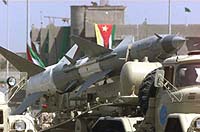
Tripoli (AFP) February 7, 2000 - Libya denied Monday it wanted to acquire long-range missiles, accusing the United States of "spreading such accusations in order to justify its domination of Europe and the Mediterranean". "The allegations of (US Defense Secretary) William Cohen that Libya and other countries are seeking to acquire missiles capable of hitting US and European soil do not stand up to reality," the spokesman of the foreign ministry in Tripoli said. On Saturday, Cohen said that Iran, Iraq, Libya and North Korea were seeking to acquire or planned to equip themselves with long-range missiles which could hit US territory as well as Europe. "These allegations are made to justify the US domination of Europe and the Mediterranean as well as the enlargement of NATO by (inclusion of) countries of the East and the South," the spokesman said. He demanded that US officials "refrain from mentioning Libya's name in their accusations". On January 22, Libya denied trying to acquire missiles with a range of more than 1,000 kilometres (600 miles) from North Korea, which could have reached Israel and the south of Europe. The allegation was made in the Spanish daily El Pais, quoting a Spanish secret service report. In January British customsmen said they had discovered 32 crates of missile parts packed under the name of a knitwear firm as they were about to be flown to Tripoli via Malta. Arms sales to Libya are still banned under the terms of a European Union embargo and an international treaty prohibiting the proliferation of ballistic missiles. Defence experts said the assembled Scud missiles would have had a range of around 900 kilometres (560 miles). The Sunday Times, which made the find public, claimed documents found with the crates indicated a series of parts had already made it safely to Tripoli.
Copyright 1999 AFP. All rights reserved. The material on this page is provided by AFP and may not be published, broadcast, rewritten or redistributed.
MILSPACE
|
|
| |||||||||
| The content herein, unless otherwise known to be public domain, are Copyright 1995-2016 - Space Media Network. All websites are published in Australia and are solely subject to Australian law and governed by Fair Use principals for news reporting and research purposes. AFP, UPI and IANS news wire stories are copyright Agence France-Presse, United Press International and Indo-Asia News Service. ESA news reports are copyright European Space Agency. All NASA sourced material is public domain. Additional copyrights may apply in whole or part to other bona fide parties. Advertising does not imply endorsement, agreement or approval of any opinions, statements or information provided by Space Media Network on any Web page published or hosted by Space Media Network. Privacy Statement All images and articles appearing on Space Media Network have been edited or digitally altered in some way. Any requests to remove copyright material will be acted upon in a timely and appropriate manner. Any attempt to extort money from Space Media Network will be ignored and reported to Australian Law Enforcement Agencies as a potential case of financial fraud involving the use of a telephonic carriage device or postal service. |
 Washington (AFP) January 28, 2000 - US Defense Secretary William Cohen expressed confidence Friday in the National Missile Defense (NMD) system despite a failed test over the Pacific last week, revealing that the interceptor missile came within 100 feet (30 meters) of its target.