|
 |
 |
 |
 |
 |
 |
 |
 |
 |

| . |  |
. |
Are There Earth-Like Planets Near Other Stars
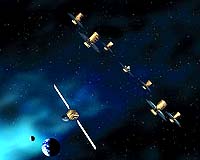
The Max Planck Institute for Astronomy in Heidelberg has organized the first international conference with the emphasis on the space missions "DARWIN" and "Terrestrial Planet Finder" Two extremely demanding space missions, "DARWIN" (ESA) and "Terrestrial Planet Finder" (NASA), are scheduled to search for planets outside our solar system (extrasolar) starting in 20014. The first international conference to prepare for these missions will be held in Heidelberg April 22 -25, 2003. Prominent scientists and space technology experts will participate, among them Prof. Steven Beckwith (Baltimore), Director of the Space Telescope Science Institute; Prof. Michel Mayor (Geneva), the discoverer of the first extrasolar planet; and Prof. Jill Tarter (Mountain View, USA), Director of the SETI Research Institute. The first planet orbiting a star other than our Sun was detected in 1995. With this fundamental discovery, the eternal question of the cosmic uniqueness of our life-bearing Earth was removed from the realm of pure speculation and put on a firm scientific basis. Astronomers all over the world immediately began collaborations to extend this basis and to interpret the newly obtained observational results. To date, more than one hundred extrasolar planets are known. These are all "giant planets", similar to (or even larger than) Jupiter. They are also located quite close to their parent stars, simplifying the detection process. Because of their size and proximity to their suns, these planets are not likely to harbor life. Finding planets similar to the Earth is considerably more difficult, and so far, none are known outside our solar system. The detection of terrestrial extrasolar planets and the detailed study of the conditions prevailing on their surfaces, including the potential presence of life, will require a variety of technological breakthroughs. Both ESA in Europe and NASA in the United States have accepted this challenge and are preparing two extremely demanding international space missions: "DARWIN" (ESA), and "Terrestrial Planet Finder" (NASA). Both missions are planned for launch in the year 2014. Figure: The Darwin mission, planned by ESA, will be composed of a fleet of eight spacecraft. Instead of an orbit around the Earth, the Darwin spacecraft will be placed in an orbit far beyond the Moon. At a distance of 1.5 million kilometres from Earth, in the opposite direction from the Sun, it is a special location, known as the Lagrangian point (L2), named after its discoverer, Joseph Louis Lagrange (1736-1813). L2 is the second of five points of equilibrium in an orbital system containing two massive bodies, in this case, the sun and the earth. Darwin will operate from L2. Darwin will search out planets similar to the earth and detect chemical traces of life in the atmosphere of each planet. Six spacecraft will carry the telescope, the seventh will bundle the light so as to simulate a giant reflector, and the eighth spacecraft will communicate between the earth and the fleet. The mission is currently undergoing assessment and is planned to be launched in 2014. Related Links More about Darwin SpaceDaily Search SpaceDaily Subscribe To SpaceDaily Express  Shock Waves Through Solar Nebula May Explain Water-Rich Space Rocks
 Tucson - Jan 24, 2003
Shock waves through icy parts of the solar nebula could well be the mechanism that enriched meteorites with water -- water that some believe provided an otherwise dry Earth with oceans, according to a new study published in the current issue of Science (Jan. 24).
|
|
| |||||||||
| The content herein, unless otherwise known to be public domain, are Copyright 1995-2016 - Space Media Network. All websites are published in Australia and are solely subject to Australian law and governed by Fair Use principals for news reporting and research purposes. AFP, UPI and IANS news wire stories are copyright Agence France-Presse, United Press International and Indo-Asia News Service. ESA news reports are copyright European Space Agency. All NASA sourced material is public domain. Additional copyrights may apply in whole or part to other bona fide parties. Advertising does not imply endorsement, agreement or approval of any opinions, statements or information provided by Space Media Network on any Web page published or hosted by Space Media Network. Privacy Statement All images and articles appearing on Space Media Network have been edited or digitally altered in some way. Any requests to remove copyright material will be acted upon in a timely and appropriate manner. Any attempt to extort money from Space Media Network will be ignored and reported to Australian Law Enforcement Agencies as a potential case of financial fraud involving the use of a telephonic carriage device or postal service. |