
 |
 |
 |
 |
 |
 |
 |
 |
 |
 |

| . |  |
. |
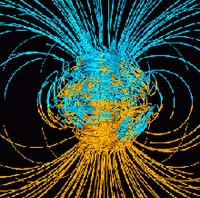
Santa Cruz - Feb. 23, 2000 - Deep in Earth's interior is a dynamo that creates the planet's magnetic field -- a kind of generator driven not by spinning turbines but by swirling flows of liquid iron. The workings of this dynamo cannot be observed, but scientists have used computer simulations to gain powerful new insights into the operation of the "geodynamo" and the behavior of Earth's core. The first self-consistent, three-dimensional computer simulation of the geodynamo was achieved in 1995 by Gary Glatzmaier, now a professor of earth sciences at the University of California, Santa Cruz, and Paul Roberts, professor of mathematics at UCLA. Glatzmaier, Roberts, and their coworkers have since refined and extended their simulations, shedding new light on the planet's inner workings. Glatzmaier presented the group's latest findings on Sunday, February 20, at the annual meeting of the American Association for the Advancement of Science in Washington, D.C. The Glatzmaier-Roberts model of the geodynamo is essentially a complex set of equations describing the physics of Earth's core. Scientists had long speculated that the mechanism behind the geomagnetic field involved the motion of the Earth's fluid outer core, which surrounds a solid inner core. Both are composed mainly of iron. The solid inner core is about the size of the moon and as hot as the surface of the sun. The flow of heat from the core ultimately drives the geodynamo. "Basically, the whole thing works because the Earth is cooling off," Glatzmaier said. The cooling process results in fluid motions in the outer core that produce an electric current, which, like any electric current, generates a magnetic field.
One of the initial achievements of the Glatzmaier-Roberts model of the geodynamo was the simulation of a reversal of Earth's magnetic field, when the north and south magnetic poles trade places. This phenomenon has occured many times in the history of the planet, according to paleomagnetic records preserved in rocks that show the direction and strength of Earth's magnetism at the time the rocks formed. "We were able to get a magnetic field generated by the model that looks a lot like the Earth's and undergoes reversals," Glatzmaier said. The model also predicted that the solid inner core should rotate slightly faster than the surface of the Earth. This prediction was later supported by other researchers using evidence from seismic waves that pass through the core. Over the past five years, Glatzmaier and his coworkers have improved the precision and resolution of their model, taking advantage of advances in computer capacity. They have now run simulations spanning as much as 300,000 years and showing a pattern of magnetic-field reversals very similar to that seen in the paleomagnetic record. "We can run the simulation for 200,000 years and the magnetic field will be stable for a very long time -- millions of time steps for which we solve these equations. Then within a thousand years it reverses polarity, and then it remains stable again for another long period. We were very happy to see that, because that's also what we see in the Earth's record," Glatzmaier said. He noted that the reversals are not triggered by an external influence on the geodynamo. "It is simply due to the very nonlinear, chaotic nature of the dynamo system," he said. The group's most recent efforts have focused on the role of the mantle in controlling the frequency of geomagnetic reversals. Temperature variations in the mantle, causing an uneven pattern of heat flow from the outer core into the mantle, may affect the fluid dynamics of the outer core. So Glatzmaier's group ran their simulation using eight different patterns of heat flow across the core-mantle boundary. The results, published in the October 28, 1999, issue of the journal Nature, showed that the pattern of heat flow determined by the mantle does have a big influence on the behavior of the geodynamo. The most Earthlike pattern of magnetic-field reversals occurred with a relatively uniform heat-flow pattern. This suggests that scientists may have overestimated the extent of thermal variation in the mantle, or that variations in mantle composition may compensate for thermal variations. "We're still far from satisfied that we have all the answers," Glatzmaier said. "The model is a way of exploring the unknown, and it looks very promising because the results are so much like the real magnetic field. But we have less confidence in the details, and that's where more powerful computers will help."
TERRADAILY.COM
|
|
| ||||||||||
| The content herein, unless otherwise known to be public domain, are Copyright 1995-2016 - Space Media Network. All websites are published in Australia and are solely subject to Australian law and governed by Fair Use principals for news reporting and research purposes. AFP, UPI and IANS news wire stories are copyright Agence France-Presse, United Press International and Indo-Asia News Service. ESA news reports are copyright European Space Agency. All NASA sourced material is public domain. Additional copyrights may apply in whole or part to other bona fide parties. Advertising does not imply endorsement, agreement or approval of any opinions, statements or information provided by Space Media Network on any Web page published or hosted by Space Media Network. Privacy Statement All images and articles appearing on Space Media Network have been edited or digitally altered in some way. Any requests to remove copyright material will be acted upon in a timely and appropriate manner. Any attempt to extort money from Space Media Network will be ignored and reported to Australian Law Enforcement Agencies as a potential case of financial fraud involving the use of a telephonic carriage device or postal service. |
 Washington - December 13, 1999 - A rare space weather event May 11 marked by a sharp decrease in solar wind helped cause Earth's magnetosphere to balloon to more than 100 times its normal volume, reaching nearly to the moon in the process, according to a new study.