
 |
 |
 |
 |
 |
 |
 |
 |
 |
 |

| . |  |
. |
Hong Kong - December 2, 1999 - Ta Kung Pao, a pro-Beijing newspaper in Hong Kong reported yesterday that the Shenzhou capsule was the product of testing in the wind tunnel facility in Chengdu, the provincial capital of Sichuan. The eight wind tunnels in the facility, the largest cluster of such in Asia, can test aerodynamic, thermal and reentry dynamic properties of missiles, satellites, and space capsules. When the government decided to establish a manned space program in 1992, the facility was assigned the task to model Shenzhou, test the thermal and structural dynamics of it, and finalize its design. The model had undergone testing in supersonic and hypersonic conditions. Also tested were low density ablative materials, and their thermal conductivity, for the reentry module. These tests helped solve the technical difficulties in selecting ablative material, thermal shielding, control and stability of the capsule, and aerodynamic loading on the capsule during launch. According to aerospace specialists in China, the successful mission of Shenzhou paves the way for several more test flights of the manned capsule. These specialists believe that China can launch its first taikonaut before 2005. In another report in today's Chinese language Science and Technology Daily newspaper (in China), a dosmetic large scale space environment simulator for testing space vehicles has recently passed certification in Beijing. The simulator can simulate space conditions such as vacuum, hot and cold cycles, and solar radiation. The report says that the simulator is one of the three largest of such facility to test manned space vehicles in the world, and its quality reaches international level. According to the report, the completion of the simulator represents a breakthrough in space environment simulation facility and technologies in China, and will satisfy future demand in testing of space vehicles.
A POWERFUL DRAGON
|
|
| |||||||||
| The content herein, unless otherwise known to be public domain, are Copyright 1995-2016 - Space Media Network. All websites are published in Australia and are solely subject to Australian law and governed by Fair Use principals for news reporting and research purposes. AFP, UPI and IANS news wire stories are copyright Agence France-Presse, United Press International and Indo-Asia News Service. ESA news reports are copyright European Space Agency. All NASA sourced material is public domain. Additional copyrights may apply in whole or part to other bona fide parties. Advertising does not imply endorsement, agreement or approval of any opinions, statements or information provided by Space Media Network on any Web page published or hosted by Space Media Network. Privacy Statement All images and articles appearing on Space Media Network have been edited or digitally altered in some way. Any requests to remove copyright material will be acted upon in a timely and appropriate manner. Any attempt to extort money from Space Media Network will be ignored and reported to Australian Law Enforcement Agencies as a potential case of financial fraud involving the use of a telephonic carriage device or postal service. |
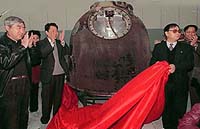
 Sydney - December 1, 1999 - Technically, the first flight of China�s Shenzhou crew-carrying spacecraft ended 21 hours after liftoff, when its descent module parachuted to a landing in Inner Mongolia. In more general terms, the mission is still not complete.