|
|
|
 NASA Tests Shuttle Skin To Gauge Strength
Houston TX (UPI) Jan 20, 2005 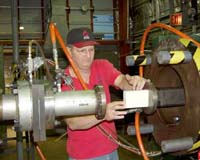 The U.S. space agency says bits of insulating foam less than half an ounce can damage the space shuttle's skin, the New York Times said Thursday.
 |
|
Space Watch: Cooperation's Failure At ISS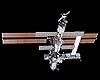 Washington DC (UPI) Jan 20, 2005
The recent Russian decision to cease transporting U.S. astronauts to the ISS after 2005 highlights two harsh realities few Americans have been willing to face: the Clinton administration did not plan well in building the ISS and the new Bush space exploration initiative has compounded the problem. New AFSPC Website Provides Worldwide Space Surveillance Support  Peterson AFB CO (SPX) Jan 20, 2005
Air Force Space Command began a pilot program Jan. 3 designed to provide space surveillance support to Commercial and Foreign Entities. |
Lunar Colony To Run On Moon Dust London, UK (SPX) Jan 20, 2005
Simulated moon dust has been used to make a key component of a working solar cell, giving an unexpected boost to President George W. Bush's project of setting up a colony on the moon, reports New Scientist. Alex Freundlich and his colleagues at the University of Houston in Texas came up with the idea of getting robotic rovers to build solar cells entirely out of "regolith" Kosmos 3 Launches Multiple Satellites  Moscow, Russia (SPX) Jan 21, 2005
A Kosmos-3M booster launched from the Plesetsk launching site in northern Russia on Thursday has successfully orbited a Kosmos-2414 series military spacecraft and the Universitetsky (Tatyana) satellite. |
JSAT Report On JCSAT-1B Satellite Anomaly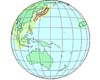 Tokyo, Japan (SPX) Jan 20, 2005
JSAT Corporation reported Wednesday that its JCSAT-1B communications satellite experienced an anomaly on January 17, 2005 at 21:26 JST, leading to difficulties with services provided by the satellite. Below are details of the incident to date and how JSAT is responding. Mars Society Canada Urges Canadian Involvement In Worldwide Space Initiatives  Montreal QC (SPX) Jan 21, 2005
Mars Society Canada have prepared a position paper on Canada Joining the International Thrust in Space Exploration, in which they explain why greater support of the Canadian Space Agency has become so important for Canada. |
CNES' Parasol Provides Its First Images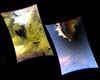 Paris, France (SPX) Jan 20, 2005
The PARASOL micro satellite (Polarization and Anisotropy of Reflectance for Atmospheric Sciences coupled with Observations from a Lidar), launched December 18, has provided its first images January 7, which confirm that the satellite, its instruments and the ground-based systems are working properly. Methane World Is Truely Titanic  Moffet Field CA (SPX) Jan 20, 2005
University of Hawaii astronomer Toby Owens spoke with Astrobiology Magazine shortly after the successful Huygens mission had completed. In this second part of the interview, Owens talks about the significance of methane in Titan's atmosphere. |
In The Stars: Neighboring Life Is Looming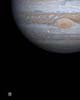 Washington DC (UPI) Jan 20, 2005
For the past four decades, spacecraft from Earth have been probing the other worlds of the solar system. During that time, these robotic machines have collected a massive amount of data about the composition and dynamics of our neighboring worlds. Anthropologists Find 4.5 Million-Year-Old Hominid Fossils In Ethiopia 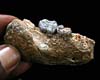 Bloomington IN (SPX) Jan 20, 2005
Scientists from Indiana University Bloomington and seven other institutions have unearthed skeletal fossils of a human ancestor believed to have lived about 4.5 million years ago. |
First Evidence That Young Low-Mass Objects Are Twice As Heavy As Predicted Tucson AZ (SPX) Jan 20, 2005
Although mass is the most important property of stars, it has proved very hard to measure for the lowest mass objects in the universe. Thanks to a powerful new camera, a very rare, low-mass companion has finally been photographed. Astronomers: 'Bullet Star' Shines 350 Times Brighter Than The Sun  Atlanta GA (SPX) Jan 19, 2005
For decades, scientists have observed that Regulus, the brightest star in the constellation Leo, spins much faster than the sun. But thanks to a powerful new telescopic array, astronomers now know with unprecedented clarity what that means to this massive celestial body. |
Envisat Monitors B-15A's Close Encounter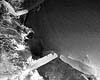 Paris, France (ESA) Jan 20, 2005
Some anticipated the 'collision of the century': the vast, drifting B15-A iceberg was apparently on collision course with the floating pier of ice known as the Drygalski ice tongue. Whatever actually happens from here, Envisat's radar vision will pierce through Antarctic clouds to give researchers a ringside seat. Expedition Reaches Antarctic Icecap Peak 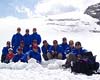 Beijing (XNA) Jan 19, 2005
A 12-man Chinese expedition surmounted the highest icecap peak in Antarctica at 3:16 a.m. Tuesday, according to the polar expedition office of the State Oceanic Administration (SOA). |
Weighing The Smallest Stars Garching, Germany (ESO) Jan 20, 2005
A star can be characterised by many parameters. But one is of uttermost importance: its mass. It is the mass of a star that will decide its fate. It is thus no surprise that astronomers are keen to obtain a precise measure of this parameter. China To Build PFR Nuclear Power Stations By 2020  Beijing, China (XNA) Jan 19, 2005
China will complete the construction of prototype fast reactor (PFR) nuclear stations by about 2020, the director with China National Nuclear Corporation (CNNC) announced here Sunday. |
| The contents herein, unless otherwise known to be public domain, are Copyright 1995-2005 - SpaceDaily. AFP and UPI Wire Stories are copyright Agence France-Presse and United Press International. ESA Portal Reports are copyright European Space Agency. All NASA sourced material is public domain. Additional copyrights may apply in whole or part to other bona fide parties. Advertising does not imply endorsement, agreement or approval of any opinions, statements or information provided by SpaceDaily on any web page published or hosted by SpaceDaily. Privacy Statement |