
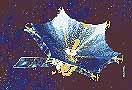
 Tokyo -- March 24, 1997 -- Following a nail-biting wait to see if its antenna could be successfully deployed, Japan's latest satellite, Muses-B is now on target to become the most powerful radio telescope of its kind ever built.
Japan's orbiting radio telescope, HALCA, has begun six months of tests following the delicate deployment of its 8-meter diameter mesh antenna Feb 28. The satellite, formerly known as Muses-B, was launched Feb. 12 on an M-5 rocket from Kagoshima Space Center, on the island of Kyushu in southern Japan.
Renamed the Highly Advanced Laboratory for Communications and Astronomy (HALCA), the satellite will concentrate on studying super-dense black holes, which lie at the center of some galaxies. HALCA is expected to be fully operational in September.
Scientists at Kagoshima waited overnight between Feb. 27 and 28 to complete the complex opening sequence of the 8-meter antenna. The deployment sequence involved extending six masts to 4.8 meters in length before locking them in place. One mast became stuck five centimeters before the locking point and required two more attempts to complete the deployment.
Looking like a spider's web with the Midas touch, the antenna uses a gold-coated molybdenum mesh connected to the six masts. "There were some tense moments and some happy moments," said Phil Edwards, a research fellow with the satellite's sponsor, the Institute of Space and Astronautical Science (ISAS). Raising the antenna was a major accomplishment for ISAS. The antenna is the largest of its kind and is the product of nine years of development by Mitsubishi Electric Corp.
"One of the most difficult points of the [hexagonal] design of the antenna was avoiding the entanglement of the cables and the nodes. We had to perform a lot of deployment tests to find the solution," said Kazuo Miyoshi, project manager in charge of building the antenna at the Mitsubishi's space division at Kamakura, outside Tokyo.
The deployment followed three perigee-raising orbital maneuvers Feb. 14, 16 and 21. These maneuvers raised the spacecraft's perigee from 220 kilometers to 575 kilometers. The perigee is the closest approach to the Earth in an orbital motion. HALCA is in a highly elliptical orbit, with an apogee, or furthest point from Earth in an orbit, to 21,400 kilometers.
The satellite's main observation targets will be active galactic nuclei, the bright radiation caused by gaseous clouds falling into giant black holes at the center of some galaxies. "These very bright galactic cores seem to be powered by super-massive black holes. When particles fall into them, they produce streams of energy we can't see in any other place," said ISAS's HALCA project manager, Prof. Hisashi Hirabayashi.
Super-massive black holes have a mass of between 1 million and 3 million times that of the solar system, Edwards said. The observations will be essential to understanding the properties of galaxies.
"We don't know how or why massive black holes are generated or how they evolved. In terms of astronomical research, how these galaxies are formed and the behavior of these phenomena are very interesting," said Prof. Makoto Inoue, team leader for the project at Japan's main astronomical organization, the National Astronomical Observatory in Mitaka, outside Tokyo.
HALCA is now undergoing basic attitude and telemetry checks with the antenna at ISAS's Usuda station, based in Nagano, central Japan. Initial observations will begin in late April or early May using Usuda's 64 meter antenna at the lowest of the satellite's three radio channels, the 1.6 gigahertz band, to be followed by tests in the 5 gigahertz and 22 gigahertz bands, Hirabayashi said. "We're cautious about when real observations will begin: each step needs to go through a lot of experiments first. We expect the first images in May," he said.
Japanese officials characterized the Muses-B launch as the most important space-based observation project since the launch of the Hubble space telescope.
HALCA ultimately will be linked to 40 telescopes in 14 different countries, reflecting the international interest in the project.
"Everyone in the astronomy community wanted this. It was natural to extend this [type of observation] into space," Inoue said.
HALCA's systems are based on the NSAS-developed Tracking and Data Relay Satellite system, a mini-constellation of three satellites which were deployed as an in-orbit feasibility study between 1986 and 1988, Hirabayashi said. The satellite's launch coincides with a number of firsts for ISAS, said Yasunori Matogawa, director of the Kagoshima launch center, as it also confirmed the future of the M-5 rocket. "the success of the M-5 has opened a new era for ISAS ranging forward into the 21st century," he said.
Apart from investigating black holes, HALCA will also concentrate on intense microwave-emitting sources called masers. Scientists are anxious to prioritize projects for the satellite, which has a two- to five-year observation life.
"HALCA cannot be repaired. It may have a very short life. We must make sure that we do the most important science first," Hirabayashi said. Candidate projects were heavily over-subscribed and had to be whittled down by an international scientific review committee, which selected 47 of 150 proposals, he said.
Related Links
SpaceDaily
Search SpaceDaily
Subscribe To SpaceDaily Express
SPACE.WIRE |