



|
|
|
|
|
|
|
|
|
|
|


| . |  |
. |
|
|
|
 by Staff Writers Paris (AFP) June 10, 2009
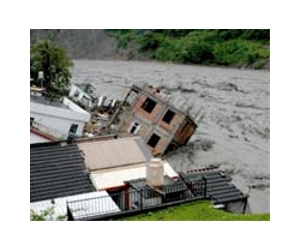
Surprised scientists say that typhoons which hit Taiwan unleash long, slow earthquakes, a phenomenon that may save the island from devastating temblors. Seismologists installed movement sensors in boreholes at depths of 200-270 metres (650-870 feet) in eastern Taiwan, monitoring a spot where two mighty plates, the Philippine Sea Plate and the Eurasian plate, bump and jostle in an oblique, dipping fault. Over five years, researchers saw a remarkable link between tropical storms and "slow" earthquakes, a seismic beast first identified three decades ago. Slow quakes entail a slippage in the fault that unfolds progressively over hours or days, rather than a sudden, violent release of the kind that destroys buildings and lives. The sensors noted 20 such slow earthquakes, 11 of which coincided with typhoons, during the study period. The 11 quakes were all stronger and characterised by more complex seismic waveforms than other "slow" events. "These data are unequivocal in identifying typhoons as triggers of these slow quakes. The probability that they coincide by chance is vanishingly small," said co-author Alan Linde of the Carnegie Institution for Science in the United States. A typhoon causes a fall in atmospheric pressure -- and the researchers suggest that this in turn reduces pressure on the land over the fault. As a result, one side of the fault lifts slightly, causing the pressure that has been building up inside to be released. "This fault [in Taiwan] experiences more or less constant strain and stress buildup," Linde said in a press release. "If it's close to failure, the small perturbation due to the low pressure of the typhoon can push it over the failure limit. "If there is no typhoon, stress will continue to accumulate until it fails without the need for a trigger." The typhoon does not work as a seismic trigger on faults that lie on the seabed because water moves into the area, dampening out any difference in pressure, they theorise. Often considered a curse, typhoons -- for Taiwan -- could in fact could be a blessing. A storm could act as a pressure valve, preventing strain from building up to the point where the fault ruptures devastatingly. The Nankai Trough, in southwestern Japan, also lies on the convergence of the Philippine Sea and Eurasian plates. The plates are converging at about four centimetres (2.5 inches) per year, which is about half that of the activity in Taiwan. In theory, Taiwan should be more vulnerable than the Nankai Trough because of the greater slippage, but the record shows that it has had no great earthquakes and relatively few large quakes, said Linde. By comparision, the Nankai Trough is capable of unleashing a true monster, a magnitude-8 earthquake, every 100 to 150 years. The paper, published in the British journal Nature, is led by Chiching Liu of the Institute for Earth Sciences at Academic Sinica, Taipei.
Related Links Bringing Order To A World Of Disasters When the Earth Quakes A world of storm and tempest
|
|
|
| The content herein, unless otherwise known to be public domain, are Copyright 1995-2014 - Space Media Network. AFP, UPI and IANS news wire stories are copyright Agence France-Presse, United Press International and Indo-Asia News Service. ESA Portal Reports are copyright European Space Agency. All NASA sourced material is public domain. Additional copyrights may apply in whole or part to other bona fide parties. Advertising does not imply endorsement,agreement or approval of any opinions, statements or information provided by Space Media Network on any Web page published or hosted by Space Media Network. Privacy Statement |
 del.icio.us
 Digg
Digg Reddit
 Google