



|
|
|
|
|
|
|
|
|
|
|


| . |  |
. |
|
|
|
 by Staff Writers Manoa HI (SPX) Feb 07, 2011
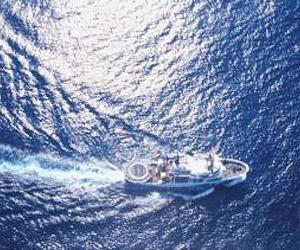
Earth's global temperature has been rising gradually over the last decades, but the warming has not been the same everywhere. Scientists are therefore trying to pin down how the warming has affected regional climates because that is what really matters to people, and to adaptation and mitigation strategies. Their efforts, however, had hit a roadblock because the necessary observations of the winds over the oceans were biased. Developing a new method to remove the bias, Hiroki Tokinaga and Shang-Ping Xie at the International Pacific Research Center, University of Hawaii at Manoa, found that their corrected observations show the trade winds in the tropical Atlantic have weakened and the pattern of ocean surface temperature has changed. As a result, the equatorial Amazon and the Guinea Coast are seeing more rainfall and the Sahel less. The findings are published online in the February 6, 2011, issue of Nature Geoscience. The raw observations of winds over the ocean suggest that the winds have grown stronger during the last 60 years. The trend is, however, largely due to a change in the placement of the anemometers, the instruments measuring wind speed. Ships are the main source of wind data over the ocean, and ships have increased in height and so has the anemometer placement. Tokinaga and Xie corrected this wind bias using wind-wave heights. The tropical Atlantic has three major ship routes along which ships provide meteorological data. Applying their new correction technique to observations along these routes from 1950 to 2009 together with other observations, they found the trade winds in the tropical Atlantic had weakened significantly during this period. Although ocean surface temperature in the tropical Atlantic has risen, the pattern has changed and with it the climate. The cold tongue of water that stretches out from the eastern tropical Atlantic coast has warmed more than the western part of the basin. At the same time, the weakened trade winds have resulted in less upwelling of cold water and nutrients in the eastern tropical Atlantic. These latter changes could impact marine life. Accompanying these changes in wind and ocean temperature is a very significant increase in rainfall, not only over the ocean but also over adjacent land areas such as the equatorial coastal regions of the Amazon and the Guinea Coast. For example, the August rainfall at Ibadan, one of the largest cities in Nigeria, has increased by 79 mm/month from 1950 to 1998, which is a whopping 93% increase over the long-term average for 1900?. The study also suggests that the year-to-year variations of ocean temperature and rainfall have weakened during recent decades, implying fewer extreme events. Tokinaga and Xie reason that the pattern of ocean warming and trade-wind changes are caused by the asymmetric reduction in surface solar radiation due to man-produced aerosols, the reduction affecting the Northern more than the Southern Hemisphere. If aerosol emissions decrease over the next decades, the tropical Atlantic climate may experience yet another shift as greenhouse gas forcing increases. Such a shift in the patterns of climate change (i.e., precipitation and sea level) will have important impacts on the socio-economics of regions surrounding the tropical Atlantic. For example, "If the year-to-year variability is to recover in the future, the resulting increase in climate extremes would add burdens to an ecosystem and to a society already stressed by global warming," said Tokinaga. Historical observations of accurate winds are gravely lacking over the World's oceans. This new robust and physically consistent set of observations by the IPRC team is valuable for improving computer models and evaluating model projections of climate change under further global warming.
Related Links University of Hawaii at Manoa Water News - Science, Technology and Politics
|
|
|
| The content herein, unless otherwise known to be public domain, are Copyright 1995-2014 - Space Media Network. AFP, UPI and IANS news wire stories are copyright Agence France-Presse, United Press International and Indo-Asia News Service. ESA Portal Reports are copyright European Space Agency. All NASA sourced material is public domain. Additional copyrights may apply in whole or part to other bona fide parties. Advertising does not imply endorsement,agreement or approval of any opinions, statements or information provided by Space Media Network on any Web page published or hosted by Space Media Network. Privacy Statement |
 del.icio.us
 Digg
Digg Reddit
 Google